

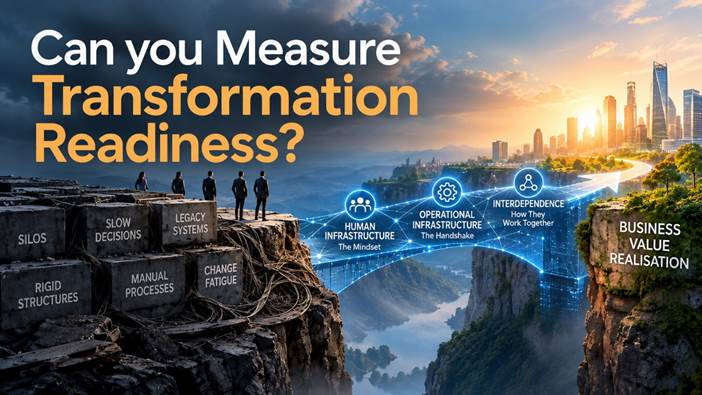
Change requires the organisation to DO something different. Transformation requires the organisation to BE something different.
Those may sound like two ways of saying the same thing.
They aren’t.
And the distinction matters enormously when an organisation is investing millions in digital transformation, AI, technology modernisation or a fundamental change to the way it operates.
Because if transformation requires the organisation to BECOME something different, then one of the most important questions before — and throughout — the transformation is:
Is the organisation capable of becoming what the transformation requires it to become?
That is the question behind Transformation Readiness.
Transformation is not a destination
We often talk about transformation as though it were a project with a beginning, a middle and an end.
- There is a business case.
- A programme is approved.
- Technology is selected.
- Implementation begins.
- The system goes live.
- The project closes.
- And everyone moves on.
But transformation doesn’t really work like that.
Transformation is an ongoing process of fundamental adaptation — in mindset, behaviour, structure and the way the organisation operates.
If transformation were simply a destination, you could arrive, stop and declare yourself transformed.
But organisations don’t work that way.
Each milestone creates the foundation for the next level of development.
A transformation therefore isn’t simply about getting from where we are to where we want to be.
It is about developing the organisational capability to operate successfully at that new level.
That changes the question we need to ask.
Not simply:
“Are we ready to start?”
But:
“What will this transformation require the organisation to be capable of doing — and are we capable of doing it?”
So, what is Transformation Readiness?
Transformation Readiness is not simply an assessment of whether people are ready for change.
It is about identifying and managing the organisational capabilities the transformation depends on — through to value realisation.
That distinction is important.
- A transformation may be technically ready to launch.
- The project team may be in place.
- The funding may be approved.
- The technology may be ready.
- The implementation plan may be sound.
And yet the organisation may still lack the capabilities required to turn that transformation into business value.
That is the gap Transformation Readiness is intended to expose.
How do you measure something as complex as an organisation?
This is where Unitary Development Theory (UDT) provides a different perspective.
UDT measures Transformation Readiness not by asking whether employees like the change or whether they feel positive about it.
It looks at the capability maturity of the organisation as a system.
And by system, we mean the entire organisational “human organism”:
- the people;
- the structures;
- the behavioural patterns;
- the cultural habits;
- the ways decisions are made;
- the way information flows;
- and the governance rules that determine how the organisation actually functions.
The question becomes:
What is this organisational system actually capable of executing?
That is a very different question from:
How do people feel about the transformation?
Both may be useful questions.
But they tell you different things.
The three elements of organisational capability
UDT looks at the interplay between three elements.
1. Human Infrastructure — the mindset
This is the collective psychological capability of the organisation.
It includes things such as:
- psychological safety;
- tolerance for ambiguity;
- how failure is handled;
- how people respond to uncertainty;
- and whether managers are able to coach rather than simply command.
These characteristics affect what people are capable of doing within the system.
2. Operational Infrastructure — the handshake
This is how the organisation is structurally wired.
It includes:
- workflows;
- cross-functional dependencies;
- performance measures;
- information flows;
- decision rights;
- and the mechanisms through which work gets done.
Consider a simple example.
A frontline team may have access to information that would allow them to make a decision immediately.
But if they have to submit a request, wait for another department, obtain approval and then wait for the information to move through another process, the organisation itself is creating a constraint.
The capability isn’t necessarily missing in the individual.
The system is constraining the capability.
3. Interdependence — how the parts work together
An organisation is not simply the sum of its individual capabilities.
It is also defined by how those capabilities interact.
Imagine a highly innovative data scientist working within a rigid, siloed hierarchy.
The individual may have the capability to operate at a very high level.
But if the surrounding organisational system operates at a much lower level of maturity, the system will constrain what that person can actually achieve.
Eventually, the individual either adapts to the system or leaves it.
The system wins.
That is why measuring individual capability alone isn’t enough.
We need to understand the capability of the organisational system.
The CIO’s AI problem
This becomes particularly important with AI and digital transformation.
Consider your AI platform.
- The software may be highly sophisticated.
- It may be capable of processing information in real time, identifying patterns and generating insights almost instantaneously.
- But that technology doesn’t operate in isolation.
It has to run inside your organisation.
Your organisational culture, structures, processes, decision rights and governance become the environment in which that technology has to operate.
A useful analogy for a CIO is this:
Your new AI platform is advanced software. But your organisation’s culture, silos and approval hierarchies are the hardware it has to run on.
If you try to run high-speed, real-time AI software on slow, outdated bureaucratic “hardware”, the system will struggle.
And the problem may not appear as a technology failure.
It may appear as:
- people reverting to spreadsheets;
- teams creating workarounds;
- increasing change fatigue;
- shadow IT;
- talented people becoming frustrated;
- decisions remaining stuck in committees;
- or technology being technically deployed but poorly adopted.
The technology may be working perfectly.
The organisation may simply not be capable of using it in the way the transformation requires.
That is a Transformation Readiness problem.
UDTs Three Zones
One way of understanding this is to look at the relationship between technical ambition and organisational maturity.

1. The System Rejection Zone
High ambition + low organisational maturity
Imagine an organisation introducing advanced AI, predictive analytics and real-time decision-making while its operating model remains dominated by:
- rigid functional silos;
- command-and-control leadership;
- slow approval hierarchies;
- and a low tolerance for experimentation or failure.
The transformation is asking the organisation to operate at a level it has not yet developed the capability to support.
The result can be change fatigue, workarounds, manual processes and shadow IT.
The system begins to reject the transformation.
2. The Balanced Value Zone
Technical ambition matches organisational maturity
Here, the organisational system has developed the capabilities required to support the technology.
Advanced data capabilities are supported by:
- more decentralised decision-making;
- cross-functional collaboration;
- appropriate authority at the frontline;
- transparent information flows;
- and structures capable of responding at the required speed.
The technology can therefore accelerate what the organisation is already capable of doing.
This is where the potential for business value realisation is strongest.
3. The Underutilised Zone
High organisational maturity + low technical ambition
The relationship can work in the other direction too.
An organisation may have relatively mature, collaborative and flexible structures but still depend on outdated, legacy technology.
The organisation has the capability.
The technology is holding it back.
The result can be frustration, inefficiency and the loss of skilled people who are being constrained by legacy systems.
Transformation Readiness is a journey
Transformation Readiness therefore isn’t something you establish once at the beginning of a project and then put away.
It changes as the organisation changes.
The journey can involve four broad phases:
- Awareness
Recognising the gaps, outdated habits or operational limitations that need to change. - Introspection
Understanding purpose, values and the capabilities required for the future. - Action & Adaptation
Making iterative changes while operating through ambiguity and learning from setbacks. - Reinvention
Continuously reviewing and refining the organisation as its environment changes.
And there will be pitstops along the way.
- The Wake-Up Call.
- The Messy Middle.
- The Plateau.
- The Breakthrough.
And the Reflection that asks:
What have we learned, and what does the next level require?
That is why transformation cannot be reduced to a project plan.
The organisation itself is developing.
So, can Transformation Readiness actually be measured?
Yes, it can.
But not by reducing readiness to a question about whether people feel ready.
And not by assuming that because a transformation can be delivered, the organisation is therefore capable of realising its intended value.
The more useful question is:
What capabilities does this transformation require — and does the organisation currently have the maturity to execute them? And, if not, what can we do about it?
That gives the CIO and the wider executive team something much more useful than a generic readiness score.
It gives them a way to identify where the Capability Maturity Gap exists.
And once that gap is visible, it becomes possible to ask:
- What does the transformation depend on?
- Where are the organisational constraints?
- Which capabilities need to develop?
- Which risks need to be addressed before implementation?
- Which need to be managed throughout the transformation?
- And how does this connect to business value realisation?
That is the real purpose of measuring Transformation Readiness.
Not to produce a score.
But, to provide information that allows the organisation to make better decisions about its transformation.
The question to ask right now
You don’t have to wait for the next transformation to assess Transformation Readiness.
If you are already in the middle of a transformation, now is the time to ask.
Because the earlier a capability gap becomes visible, the more options you have to address it.
Once the transformation is underway, the consequences of an organisational capability gap can start appearing as missed milestones, frustrated teams, workarounds, slow adoption, escalating costs, poor decision-making or technology that isn’t delivering the expected value.
By then, the gap has become a problem.
Transformation Readiness gives you the opportunity to identify that risk before it gets that far.
So, whether your transformation is being planned, is already underway, or has reached the point where the expected business value isn’t materialising, ask:
Does our organisation have the capability required to make this transformation work — and where are the gaps that could put the value at risk?
You don’t need to wait until the transformation is in trouble to find out.
Measure the readiness now. Before the capability gap becomes the problem.
Find out how ready your transformation really is
Whether your transformation is already underway or still being planned, you can assess its Transformation Readiness now.
Talk to us about the UDT/DMI Diagnostic.
It can help identify the organisational capability gaps that could put your transformation — and the business value it is intended to deliver — at risk.
Finding those gaps early can save time, money and frustration, and help avoid the far more costly and embarrassing situation of delivering the transformation successfully but not achieving the business goals it was meant to deliver.
If you’d like to explore the subject further, visit our Blog and Knowledge Base for more on Transformation Readiness, organisational capability and business value realisation.