

There is a particular challenge that comes with being a CIO today.
You may be responsible for delivering the transformation.
- You may be accountable for the technology investment.
- You may be expected to demonstrate business outcomes.
- You may be sitting in every steering committee meeting where progress, risk and benefits are discussed.
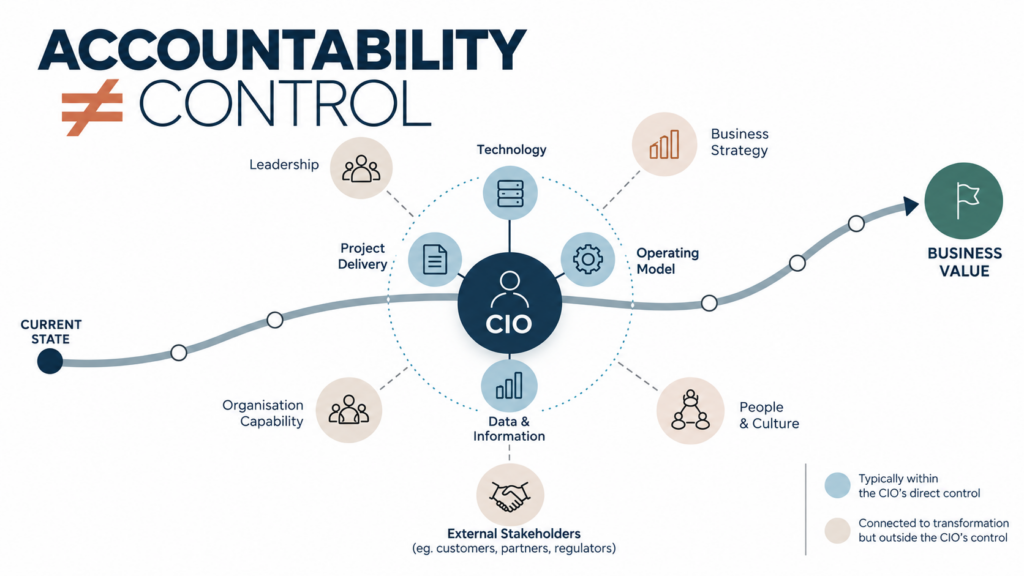
And yet, many of the things that determine whether the organisation actually realises the business value of that transformation are not under your control.
That creates an uncomfortable question:
How do you lead a transformation when you don’t control everything that makes it successful?
I think this is becoming one of the most important leadership questions facing CIOs.
Not because CIOs are failing to lead.
But because the scope of what they are being asked to deliver has expanded considerably beyond the boundaries of technology.
Delivery is visible. Value realisation is harder.
Most transformation programmes have a very clear definition of delivery.
- The technology has been implemented.
- The system is live.
- The migration is complete.
- The programme is on schedule.
- The budget is under control.
- The milestones have been achieved.
These things matter.
But they are not the same thing as business value realisation.
The technology may be working perfectly while the organisation is still struggling to realise the intended value.
- Perhaps the business processes haven’t changed sufficiently.
- Perhaps decision-making remains too slow.
- Perhaps leaders haven’t changed the way they manage.
- Perhaps people don’t yet have the capabilities required to work differently.
- Perhaps different parts of the organisation are optimising for different outcomes.
- Perhaps the operating model hasn’t caught up with the technology.
- Perhaps the organisation simply isn’t ready to absorb what the transformation is asking of it.
None of these necessarily mean that the technology transformation has been poorly delivered.
They mean that transformation delivery and value realisation are not the same thing.
And that distinction matters enormously for the CIO.
The accountability gap
This is where the CIO dilemma begins.
The capabilities required to realise the value of a transformation rarely sit entirely within IT.
They can involve:
- business leadership;
- operating model;
- organisational structure;
- decision-making;
- processes;
- workforce capability;
- leadership alignment;
- culture;
- customer-facing capabilities;
- finance;
- risk and governance;
- and technology.
The CIO can see many of these dependencies.
The CIO may even be the person most visibly accountable when the transformation doesn’t deliver the expected outcome.
But that doesn’t mean the CIO owns the underlying capabilities.
This creates a very particular accountability gap:
Accountability for transformation outcomes can move towards the CIO faster than control over the capabilities required to achieve those outcomes.
That is not necessarily a leadership failure.
It is a governance problem.
Leadership does not mean controlling everything
I think we sometimes make leadership unnecessarily difficult by assuming that effective leaders must somehow control all the factors affecting their outcomes.
They don’t.
- A CIO doesn’t need to own cybersecurity in order to govern cybersecurity risk.
- A CIO doesn’t need to own finance in order to govern technology investment risk.
- A CIO doesn’t need to own enterprise risk in order to ensure that material technology risks are visible and managed.
So, why should organisational capability be different?
A CIO does not need to become responsible for Organisation Development, HR, operating-model design or business-unit capability.
But if organisational capability can materially affect the outcome of a transformation, the CIO needs a way to see that risk, understand it and ensure that it is being governed.
That is a very different proposition from taking ownership.
And I think that distinction could change the way CIOs approach transformation leadership.
What happens when the risk isn’t visible?
Consider a transformation that depends on significantly different ways of working.
- The technology is ready.
- The implementation plan is on track.
- The training programme has been completed.
But the organisation still makes decisions through the old hierarchy.
- Business units still operate in silos.
- Performance measures still reward the old behaviours.
- Managers still allocate resources according to the previous operating model.
People have been told to work differently, but the organisation itself continues to reinforce the old way of working.
Where does that risk appear on the transformation dashboard?
- It may appear eventually as adoption problems.
- Then as delays.
- Then as resistance.
- Then as benefits not being realised.
- And eventually, perhaps, as a question about whether the transformation itself was the right investment.
By that point, the organisation may be trying to fix a capability problem after it has already become a transformation problem.
This is why Transformation Readiness matters.
Readiness isn’t simply asking whether the technology is ready to be implemented.
It is asking whether the organisation has—or can develop—the capabilities required to realise what the transformation is intended to achieve.
The CIO as the transformation shock absorber
There is another consequence of this accountability gap.
When capability risks aren’t visible within the governance structure, they often end up being absorbed by the people closest to the transformation.
And that frequently means the CIO.
The CIO becomes the person who has to:
- chase business adoption;
- resolve leadership disagreements;
- escalate delayed decisions;
- compensate for capability gaps;
- explain why benefits aren’t appearing;
- manage expectations;
- push other executives to act;
- and keep the transformation moving despite dependencies outside IT.
The transformation may technically belong to the organisation.
But the pressure becomes concentrated around the CIO.
That can make the CIO look like the problem when the real issue is that the governance model has not made the dependencies visible.
The answer isn’t necessarily for the CIO to become a better firefighter.
It may be to change what is visible in the governance conversation.
What if organisational capability became part of the risk conversation?
Imagine that, alongside programme milestones, budget, technology risks and benefits, the transformation governance process could also answer questions such as:
- What organisational capabilities does this transformation depend on?
- Which of those capabilities already exist?
- Where are the material gaps?
- Which gaps could threaten business value realisation?
- Who owns those capabilities?
- What is being done about them?
- Are they developing at the pace required by the transformation?
Now the CIO doesn’t have to personally solve every problem.
The risk has become visible.
The appropriate executive owner can be identified.
The capability can be developed where necessary.
And the governance structure can track whether the organisation is becoming more capable of delivering the intended outcome.
That is a very different way of leading transformation.
This is where leadership becomes more strategic
There is an interesting implication here for executive leadership.
The CIO’s role isn’t necessarily to have all the answers.
It may increasingly be to recognise the system of dependencies around technology and business value.
That requires a different kind of leadership.
- The ability to step back from the immediate programme.
- To distinguish delivery problems from organisational capability problems.
- To recognise when an issue sits outside your direct authority.
- To ask the question that nobody else is asking.
And, importantly, to bring the right people into the conversation without making them feel that you are simply handing them another problem.
This is one reason I think executive perspective matters so much for CIOs.
Sometimes the most useful leadership support isn’t another technical solution or another transformation methodology.
It is having someone outside the immediate delivery environment who can help you step back and examine what is actually happening in the system around you.
Not to tell you what to do.
But to help you see what you may be too close to see.
From personal accountability to organisational governance
This is perhaps the biggest shift.
If a CIO is personally carrying every organisational dependency that affects transformation, the organisation has effectively made the CIO the mechanism for managing transformation risk.
That isn’t sustainable.
And it isn’t particularly good governance.
A more mature approach is to move from:
- “The CIO needs to make this transformation succeed.”
towards:
- “The organisation needs to govern whether it is becoming capable of realising the value the transformation is intended to create.”
The CIO still has an important role.
In fact, arguably an even more important one.
But the role changes.
The CIO becomes one of the executives ensuring that organisational capability risks are visible, understood and governed—not the person expected to personally overcome every capability constraint.
That distinction matters.
Because governance does not require ownership.
So, how do you lead a transformation you don’t fully control?
Perhaps the answer isn’t to try to gain more control.
Perhaps it is to improve visibility.
Understand the capabilities the transformation requires.
Identify where the organisation may not yet be ready.
Recognise which capability gaps could become material risks to business value realisation.
Make those risks visible.
Ensure that the appropriate organisational owners are engaged.
And bring them into the transformation governance conversation early enough for something to be done.
That is a different model of transformation leadership.
One where the CIO doesn’t have to control everything.
But does have the visibility and governance mechanisms needed to ensure that what matters doesn’t remain invisible.
Because ultimately:
Transformation can be delivered.
Organisation capabilities determine value realisation.
And if the organisation is accountable for the value of its transformation, then perhaps organisational capability needs to be part of the transformation governance conversation from the beginning.
Want to explore this further?
This is part of a broader conversation we’re having about Transformation Readiness, organisational capability and the risks that sit beneath transformation delivery.
To read more on this topic—and how we’re moving from understanding the problems to exploring practical solutions—have a look at our blog.