

There is a phrase we hear increasingly often in organisations:
Change fatigue.
- People are tired.
- Teams are overwhelmed.
- There are too many initiatives.
- Too many priorities.
- Too many new systems.
- Too many restructures.
- Too many things changing at once.
And the usual response is understandable.
- Slow things down.
- Communicate better.
- Help people cope.
- Give people time to adapt.
All of those things can be useful.
But I think there is another question we don’t ask often enough:
- What if the problem isn’t simply the amount of change?
- What if part of the problem is that the organisation itself hasn’t been designed to absorb the amount of change it is now being asked to undertake?
That is a rather different problem.
And it leads to a rather different conversation.
We keep asking people to adapt to organisations that haven’t adapted
Think about what happens during a major transformation.
- The organisation introduces a new technology platform.
- Processes change.
- Roles change.
- Decision-making changes.
- Customer expectations change.
- New skills are required.
- New information becomes available.
- New performance measures are introduced.
- Sometimes the operating model changes as well.
And then we ask people to adapt.
- We train them.
- We communicate with them.
- We run workshops.
- We appoint change champions.
- We measure adoption.
And when people struggle, we often describe it as change resistance or change fatigue.
But what if some of that “fatigue” is actually a rational response to the way the organisation has been designed?
Imagine asking people to make decisions faster while retaining a structure in which every significant decision still requires multiple layers of approval.
- Or asking teams to collaborate across functions while their objectives, budgets and performance measures remain entirely functional.
- Or introducing agile ways of working while maintaining governance processes designed for annual planning and sequential delivery.
- Or asking people to innovate while punishing failure.
- Or expecting employees to work differently while their roles, processes and systems still reinforce the old way of working.
At some point, the organisation is asking people to overcome the organisation itself.
That is exhausting.
Change fatigue may be a symptom, not the problem
This is where I think we need to be careful with the language of change fatigue.
People can absolutely become exhausted by excessive demands.
But fatigue can also tell us something about the conditions in which change is happening.
If people are repeatedly being asked to change their behaviour while the organisational systems around them remain unchanged, eventually the effort required to sustain the new behaviour becomes enormous.
- The new process says one thing.
The old system enables another. - Leadership says collaboration matters.
The reward structure still recognises individual functional performance. - The transformation says decisions need to happen closer to the customer.
The governance model still pushes decisions upwards. - The organisation says it wants innovation.
The operating model still optimises for predictability and control.
People are caught in the middle.
And then we wonder why they are tired.
Transformation changes more than technology
This is one of the reasons I’ve become increasingly interested in organisational capability.
A transformation is often described in terms of what is being implemented.
- A new ERP.
- A digital platform.
- AI.
- A new CRM.
- Cloud migration.
- Automation.
- A new customer experience.
But the technology is only one part of the change.
The organisation has to be capable of operating differently because of it.
That can require changes to:
- structure;
- roles;
- decision rights;
- processes;
- skills;
- leadership;
- performance measures;
- information flows;
- governance;
- collaboration;
- customer engagement;
- ways of working.
If those things don’t change sufficiently, the organisation can end up with a strange situation.
The technology has transformed.
The organisation hasn’t.
And people are expected to bridge the gap.
This is where organisational design becomes interesting
Organisational design is too often treated as a restructuring exercise.
- Draw the boxes.
- Move some people.
- Change reporting lines.
- Rename roles.
- Announce the new structure.
- Done.
But organisational design can be much more fundamental than that.
The real question is:
How should the organisation be designed to do what it now needs to do?
That includes the structure, of course.
But it also includes how work flows through the organisation.
- How decisions are made.
- Who has authority.
- How roles interact.
- How information moves.
- How teams collaborate.
- How performance is measured.
- How resources are allocated.
- How processes work.
- How technology supports those processes.
And how all of those elements reinforce—or undermine—the behaviour the organisation needs.
That is why I don’t think organisational design should be treated as something that happens after the transformation has been designed.
In many transformations, it needs to happen alongside it.
I’ve been thinking about this for a while.
Several years ago, I wrote an ebook called “Executive’s Guide to Flexible Organisations for the NWoW”. At the time, the conversation was about the New Ways of Working, business agility and how organisations could become more flexible and responsive.
A lot has changed since then. We’re now talking about digital transformation, AI, new operating models and continuous change.
But one of the fundamental questions remains the same:
If change is constant, why not design our organisations to be capable of changing with it?
The ebook explores this from an organisation design perspective — looking beyond the organisation chart to the structures, decision-making, processes, capabilities, roles and ways of working that enable an organisation to deliver its strategy.
Looking at it now, I think the question has become even more important.
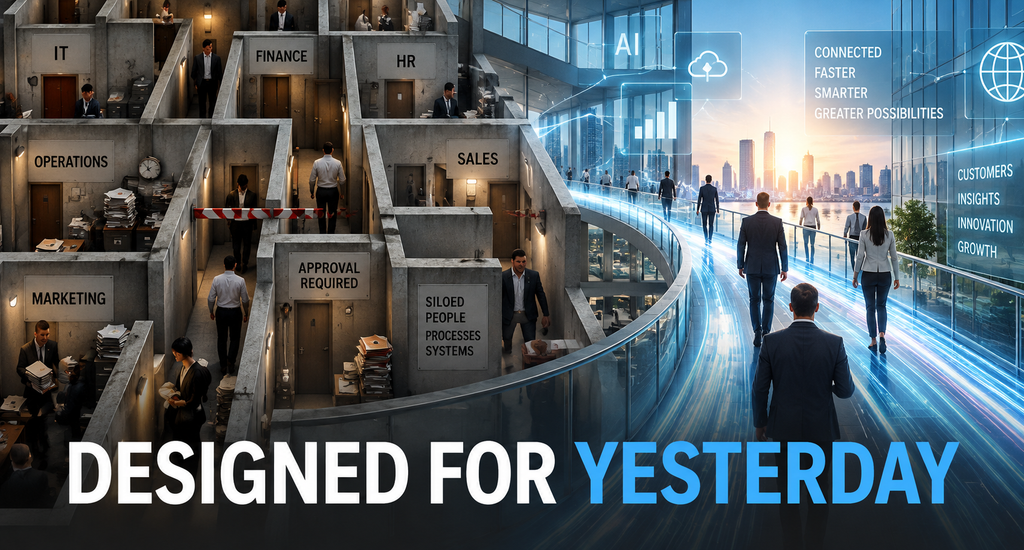
Is your organisation designed for yesterday?
The organisation may be carrying yesterday’s design into tomorrow’s strategy
There is a simple test I find useful.
- Look at what the organisation says it wants to achieve.
- Then look at how the organisation is actually designed to operate.
Do the two match?
- If the strategy requires customer-centricity but the organisation is structured around internal functions, there may be a design problem.
- If the strategy requires rapid innovation but decision-making remains highly centralised, there may be a design problem.
- If the strategy requires data-driven decisions but information ownership is fragmented, there may be a design problem.
- If the strategy requires AI-enabled work but roles and processes have been designed around human-only workflows, there may be a design problem.
- If the strategy requires continuous transformation but the organisation is designed around occasional projects, there may be a design problem.
None of these necessarily means the organisation is badly designed.
It means the organisation may be designed for a different level of capability than the strategy now requires.
That is a much more useful way of thinking about the problem.
And this matters to the CIO
This is another place where the CIO Dilemma becomes relevant.
Technology increasingly changes how organisations work.
But technology doesn’t determine the organisational design required to realise its value.
A CIO can introduce a new platform.
- They can enable automation.
- They can provide data.
- They can implement AI.
- They can modernise the technology estate.
But the organisation still must decide:
- How will work change?
- Who will make decisions?
- Which roles will change?
- Which processes will disappear?
- Which capabilities need to develop?
- What should remain centralised?
- What should move closer to the customer?
- What should humans do?
- What should technology do?
- What should AI do?
- And how will the organisation govern all of this?
Those are organisational questions.
They require leadership, operations, HR, finance, business and technology to work together.
This is why I keep coming back to the distinction between responsibility and control.
The CIO may be accountable for enabling a transformation.
But they cannot redesign the entire organisation alone.
There is another problem: we keep treating each transformation as an isolated event
This may be one of the biggest reasons organisations become exhausted.
- One transformation introduces a new operating model.
- Another introduces a new technology.
- Another changes the customer experience.
- Another restructures a business unit.
- Another introduces AI.
- Another changes the regulatory environment.
- Another follows an acquisition.
Each one has its own programme.
- Its own sponsor.
- Its own roadmap.
- Its own change plan.
- Its own communications.
But the organisation doesn’t experience them as separate programmes.
People experience one organisation.
And all the changes arrive in that organisation at the same time.
That creates an important distinction.
The transformation programme may be capable of managing its own change.
But is the organisation capable of absorbing all the changes happening across it?
That is a different question.
Sustainable change requires an organisation that can absorb change
This is where I think the conversation about Transformation Readiness needs to evolve.
Readiness isn’t just about whether an organisation can start a transformation.
It is also about whether it can absorb, sustain and build on the changes that transformation creates.
That means capability must keep developing.
- Structures may need to evolve.
- Processes may need to be redesigned.
- Roles may need to change.
- Decision-making may need to move.
- Leadership behaviours may need to adapt.
- Governance may need to evolve.
And the organisation may need to develop the capacity to change again.
Because transformation isn’t becoming less frequent.
It is becoming continuous.
The danger of solving change fatigue with more change management
This is where I think we need to challenge ourselves.
If the organisation is struggling because its structure, processes, roles and decision-making mechanisms are no longer suited to what it needs to achieve, another communication programme isn’t going to solve the underlying problem.
- Neither will another change champion network.
- Neither will another workshop explaining why people need to embrace change.
Those interventions may still have a role.
But they cannot compensate indefinitely for an organisational design that is working against the transformation.
At some point, we need to ask:
What needs to change about the organisation itself?
Designing for the future state
Perhaps this is what organisational design should really be about.
Not:
- “How do we reorganise the organisation?”
But:
- “What organisational design will enable us to operate successfully at the level the strategy now requires?”
That question starts with the future.
- What are we trying to achieve?
- What will the organisation need to be capable of doing?
- What decisions will need to be made?
- How will work flow?
- What capabilities will be required?
- What should the organisation look like?
And then:
- What needs to change between where we are now and where we need to be?
That is a very different starting point from drawing an organisation chart.
And this brings us back to Transformation Readiness
Over the last few weeks I’ve been exploring different aspects of the same underlying question.
- Can organisational capability be measured?
- Can it be developed?
- How do leaders enable it?
And now:
- Can the organisation itself be designed to support it?
Because capability doesn’t exist in isolation.
The structure, processes, roles, systems, leadership and ways of working around people either enable capability—or constrain it.
And if the transformation requires the organisation to operate differently, then those conditions matter.
- A transformation can be technically ready.
- The programme can be well managed.
- The leadership team can be enthusiastic.
- The people can be willing.
And yet the organisation can still make the desired future state unnecessarily difficult to achieve.
That isn’t necessarily a people problem.
It could just be a design problem.
Perhaps we need to stop asking people to absorb transformation
Maybe the more useful question is:
How do we design an organisation that is capable of transforming?
That is a very different ambition.
It doesn’t mean creating an organisation where change is effortless.
Change will always require effort.
It means creating an organisation where the structure, processes, decision-making, roles, leadership and capabilities make meaningful change possible and sustainable.
And that may be one of the most important organisational capabilities of all.
The ability to change.
Again.
And again.
And again.
Without requiring the organisation to break itself every time it needs to become something different.
Transformation Readiness
Transformation Readiness is not about asking whether the technology is ready.
It’s about asking whether the organisation is capable of delivering the business value the transformation is intended to create.
And that includes a question we don’t ask often enough:
Is the organisation designed to absorb and sustain the transformation it is undertaking?
Want to explore this further?
This is part of a broader conversation we’re having about Transformation Readiness, organisational capability and the risks that sit beneath transformation delivery.
To read more on this topic—and how we’re moving from understanding the problems to exploring practical solutions—have a look at our blog.
And, you can find the “Flexible Organisations” ebook and others in our Knowledge Base