

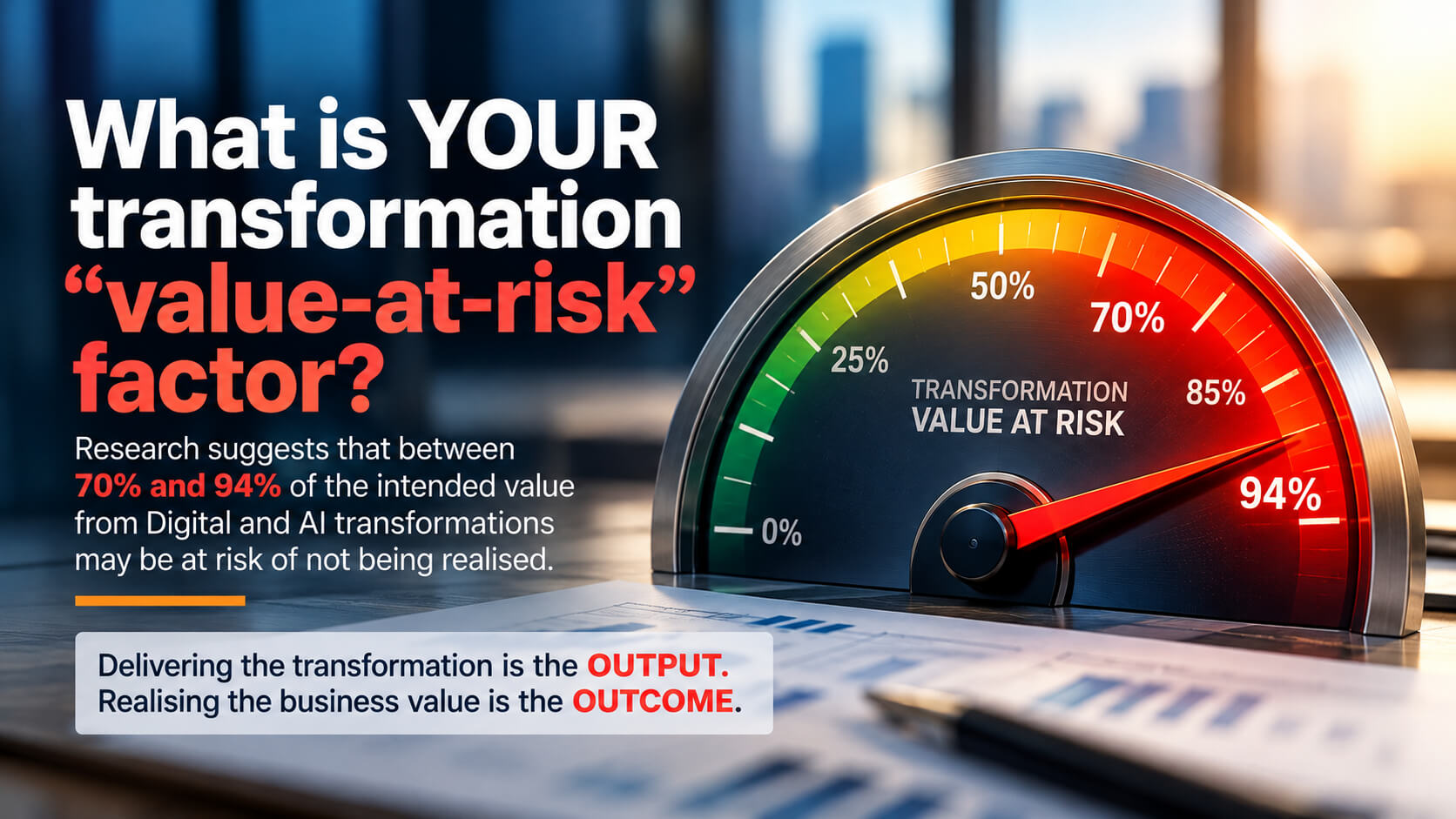
Organisations invest in Digital and AI transformation to achieve business outcomes: increased revenue, lower costs, improved customer experience, better decision-making or new opportunities for growth.
Yet delivering the transformation does not guarantee that the intended business value will be realised.
The technology may be implemented, the project completed and the budget reported.
But .. has the organisation achieved the outcomes that justified the investment? And could it have achieved more?
The financial implications: How much value is at risk?
Research into Digital and AI transformation is sending a message that business leaders cannot afford to ignore: delivering a transformation does not guarantee that the intended business value will be realised.
McKinsey’s 2025–2026 research on AI adoption and value realisation, alongside broader transformation research, highlights the persistent gap between investment and business outcomes. McKinsey has reported that 94% of businesses have not yet achieved meaningful value from AI. In South Africa, Moyo Consulting has cited estimates of AI project failure rates as high as 90%. These findings differ in scope and methodology, but they point to a significant challenge: realising the anticipated value from Digital and AI transformation is far from assured.
At the start of a Digital or AI transformation, we cannot know precisely how much of the intended value our organisation will ultimately realise. But we can use the research to understand the scale of the potential exposure.
For this article, I have used 80% as an indicative midpoint between a 70% and 94% value-at-risk scenario – a range supported by research.
Consider what that means in financial terms.
If an organisation invests R1 million in a Digital or AI transformation, an 80% value-at-risk scenario represents R800,000 of the intended business value potentially not being realised. For a R10 million investment, that becomes R8 million at risk. For a R100 million investment, it becomes R80 million.
This does not mean that the money has already been lost – but it does represent a “research-based” amount at risk. The exposure may take different forms: benefits that never materialise, value that takes considerably longer to achieve, or additional investment needed to realise the original ambition. The point is that the financial consequences can be substantial, even when the transformation itself is delivered.
The same principle applies across investment sizes. The amounts differ, but the underlying question remains: what proportion of the business value we expect from this transformation is genuinely within our organisation’s reach?
This is where research again becomes useful. It gives us reason to challenge the assumption that buying the technology, implementing the solution and completing the project will automatically produce the anticipated business outcomes.
Rather than waiting to discover a shortfall after the investment has been made, we can investigate the factors that influence value realisation before and during the transformation. We can question whether we have defined the right business outcomes, whether our organisation has the capabilities required to achieve them, and what needs to be addressed to reduce the risk. Is that not what “good governance” is about?
The research cannot tell us exactly how much value our organisation will realise. But it gives us a compelling reason to identify ways to reduce that risk— while we still have the opportunity to do it.
What is YOUR “at risk” factor? And how does that translate into “money” terms?
Are we measuring the right things?
Most Digital and AI transformations have measures for tracking progress. Budgets, milestones, implementation dates and technical performance are monitored to determine whether the project is on track.
These measures are important. They tell us whether we are delivering the transformation — but not necessarily whether we are realising its intended business value.
A system can go live on time and within budget without delivering the anticipated improvements in productivity, revenue, customer experience or operational performance. The project may be declared complete while the business benefits remain outstanding.
Measuring value realisation requires us to look beyond implementation. Are the expected benefits materialising? Are they being achieved within the anticipated timeframe? Are there additional costs or changes needed before the organisation can realise them?
And if the benefits are not materialising, do we understand why?
These are not simply questions for a post-implementation review. They are questions that need to inform decisions throughout the transformation, while there is still an opportunity to influence the outcome.
Delivering the transformation is the OUTPUT. Realising the business value of the transformation is the OUTCOME.
Are we pursuing the right value?
When organisations invest in Digital or AI transformation, they often start with familiar objectives: automate existing processes, reduce costs, improve productivity or accelerate delivery.
These are legitimate objectives. But are they the most valuable outcomes the transformation could deliver?
Digital technology and AI can do more than make existing processes faster or cheaper. They can improve accuracy, provide insights that were previously unavailable, support better decisions and enable organisations to rethink how work is performed. They may even make it possible to eliminate activities that were previously necessary because of the limitations of manual processes or earlier technology.
If we begin by asking how technology can improve what we already do, we may overlook opportunities to question whether we should be doing it that way at all.
This matters because the value we ultimately realise is influenced by the value we set out to pursue. An organisation can implement a solution successfully and achieve its original objectives, yet still fall short of what the technology could have made possible.
AI makes this question particularly important. Simply introducing AI into an existing process may produce incremental gains. Reconsidering the process, the decisions it supports, the information required and the way people work together may reveal much greater opportunities.
This is not an argument for changing everything or pursuing technology for its own sake. It is about ensuring that the business outcomes driving the investment reflect the opportunity available — rather than being constrained by “the way we’ve always done it.”
Before asking whether your organisation can realise the value of a transformation, ask whether you are pursuing the right value in the first place.
What determines whether the value is realised?
Even when an organisation has identified the right business outcomes, realising them depends on more than the technology being implemented.
A new system may provide access to better information, but people need to use that information effectively. Automation may create opportunities for greater efficiency, but roles, responsibilities and workflows may need to change. AI may enable new forms of analysis, but the organisation needs reliable data, appropriate decision-making processes and the ability to turn insights into action.
The capabilities required will depend on the transformation and the outcomes it is intended to achieve. Leadership alignment, organisational structure, operating processes, data management, technology integration, customer understanding and the way people work together may all influence the result.
These capabilities do not operate independently. A weakness in one area can constrain the value created by another. Sophisticated technology, for example, cannot compensate for data that is unreliable or inaccessible. Nor will a redesigned process deliver its intended benefits if decision-making authority, responsibilities or working practices remain unchanged.
This is why a transformation that appears sound in its business case and technical design may encounter difficulties when it meets the reality of the organisation.
The business case may assume that people will adopt new ways of working, that reliable data will be available, or that decisions can be made at the pace the new technology permits. But those assumptions are not evidence that the organisation has the capabilities required to deliver.
The question is not simply whether the technology can deliver the intended benefits. It is whether the organisation can.
What if we could identify the risks earlier?
Imagine knowing more about the organisation’s capabilities before committing to a transformation — and understanding which capabilities will be needed to realise its intended business value.
Instead of assuming that the organisation will adapt as implementation progresses, leaders could identify potential gaps and consider what needs to be developed, strengthened or changed.
This would not remove uncertainty. Transformation takes place in changing environments, and business assumptions can prove incorrect. But it would provide a stronger basis for making decisions about the investment and the organisation’s ability to realise its benefits.
It could also help leaders distinguish between different problems. Is the business case too narrowly defined? Is the technology suitable? Does the organisation lack the data foundations required? Are current operating processes, decision-making arrangements or working practices likely to constrain the intended outcomes?
These are different problems requiring different responses. Without a clear understanding of the underlying conditions, organisations risk investing in solutions without addressing what is preventing value realisation.
Identifying capability gaps early creates an opportunity to address them before they become more expensive or difficult to resolve. During the transformation, reassessing those capabilities can help leaders determine whether the organisation is developing in line with the demands of the initiative.
This is the purpose of assessing Transformation Readiness: not to guarantee success, but to understand the organisational conditions that could influence it and identify where action is needed.
From financial uncertainty to Transformation Readiness
Transformation Readiness concerns whether an organisation has the capabilities required to realise the intended business value of a specific transformation.
At TalentAlign OD, we use Unitary Development Theory (UDT) and its associated Digital Maturity Index (DMI) diagnostic to assess organisational capabilities and identify what needs to be developed to support a particular transformation.
The framework considers six interconnected Core Capabilities:
- Digital Strategy (Value Realisation): Defines the organisation’s goals and how resources, actions and technology will be aligned to achieve them.
- Digital Workplace (Value Creation): Describes how employees and stakeholders carry out their roles and activities using technology to implement organisational plans.
- Digital Offering (Value Proposition): Encompasses the products and services an organisation provides and how technology enables them to create value and competitive advantage.
- Customer Intimacy (Value Source): Reflects the knowledge, trust and relationships that enable the organisation and its customers to create mutual benefit.
- Operating Model (Value Structure): Defines how the organisation coordinates its resources and ecosystems to create value and advantage for stakeholders.
- Technology (Value Enabler): Covers how technology is designed, selected, deployed, applied and managed to support product leadership, operational excellence and customer intimacy.
These capabilities are interconnected. Their relevance and the level of capability required depend on what the organisation is trying to achieve.
The diagnostic therefore goes beyond producing a score. It helps establish which capabilities are required, where the organisation currently stands, what gaps need attention and what development is needed to support the intended outcomes.
This provides a basis for a practical roadmap. Rather than treating organisational capability as a general improvement initiative, the organisation can focus on the capabilities that matter to its transformation and the business value it expects to realise.
It also provides a way to bring organisational capability into transformation governance. Leaders can consider not only whether the project is progressing, but whether the organisation is developing the ability to deliver the expected outcomes.
The investment is only part of the equation
Digital and AI transformations create opportunities, but the financial return depends on more than the investment made or the technology delivered.
We need to ask whether we are pursuing the right business outcomes, whether our organisation has the capabilities required to achieve them, and whether we understand the gaps that could prevent the intended value from being realised.
These are questions worth asking before committing substantial resources, not only after a transformation has fallen short of expectations.
What is your transformation’s ”value-at-risk” factor — and what does that mean in financial terms?
More importantly, how are you determining whether your organisation has the capabilities required to realise the intended business value?
From Understanding the Risk to Diagnosing Transformation Readiness
At TalentAlign OD, Transformation Readiness provides a structured way to investigate that question using UDT/DMI, identify capability gaps and determine what needs to be developed to support the transformation.
To explore more about Transformation Readiness, organisational capability and business value realisation, visit the TalentAlign blog and Knowledge Base.