

There has been a lot of discussion about CIO burnout.
And understandably so.
The CIO role has changed enormously.
Today’s CIO may be expected to lead digital transformation, AI adoption, technology modernisation, cybersecurity, data transformation, innovation, customer experience and, increasingly, business transformation itself.
The expectations are enormous.
So perhaps it isn’t surprising that CIOs are under pressure.
But I’ve been wondering whether we’re looking at the problem from the wrong direction.
We tend to talk about burnout in terms of workload.
- Too many demands.
- Too many projects.
- Too many meetings.
- Too little time.
- Too much change.
All of those things are real.
But what if some of the pressure comes from something more fundamental?
What if CIOs are carrying responsibility for transformation risks that the organisation has never explicitly identified or governed?
That is a very different problem.
And it leads to a very different question:
How ready is your organisation to govern the transformation it is asking you to lead?
The CIO Has Become a Transformation Executive
There was a time when the CIO’s primary responsibility was relatively straightforward.
- Keep the technology working.
- Keep systems secure.
- Keep the business running.
- Manage the IT function.
That world has largely disappeared.
Technology is now deeply embedded in how organisations operate, compete and create value.
As a result, the CIO has moved much closer to the centre of business strategy.
They are expected to:
- enable AI;
- modernise the business;
- improve customer experience;
- strengthen cyber resilience;
- enable data-driven decision-making;
- drive innovation;
- manage increasingly complex technology environments; and
- demonstrate measurable business value from technology investment.
This is one of the most strategically important executive roles in the organisation.
It is also one of the most exposed.
Because transformation doesn’t happen inside IT.
Transformation Risk Doesn’t Stop at the IT Boundary
A CIO can ensure that the technology architecture is sound.
- They can select the right systems.
- They can manage implementation partners.
- They can establish programme governance.
- They can manage technical risk.
But can the CIO ensure that the business adopts new ways of working?
- Can they create leadership alignment across the organisation?
- Can they make business executives take ownership of new processes?
- Can they change the organisation’s culture?
- Can they ensure that people have the capabilities required by the future operating model?
- Can they make decisions happen quickly enough?
Not on their own.
Yet all of these things can determine whether the transformation delivers the business value that justified the investment in the first place.
And this is where I think the CIO dilemma becomes particularly interesting.
The CIO may be accountable for the transformation while many of the conditions required for its success sit outside the CIO’s direct authority.
The Pressure of Compensation
When those conditions aren’t in place, somebody usually compensates.
The CIO steps in.
- They escalate.
- They negotiate.
- They spend more time with business leaders.
- They intervene in problem areas.
- They become more involved in adoption.
- They push decisions through.
- They work longer.
- They keep the programme moving.
From the outside, this can look like strong leadership.
And most times it is.
But there is another possibility.
The CIO may be compensating for an organisational capability gap.
The organisation isn’t yet able to operate in the way the transformation requires.
So, the CIO becomes the mechanism that temporarily bridges the gap.
That can work for a while.
But it isn’t sustainable.
And it may help explain something about CIO burnout that isn’t captured by the usual conversation about workload.
The Capability Problem
One of the ideas that changed my thinking came from the research behind Unitary Development Theory.
One of its central principles is:
An organisation cannot sustainably operate beyond the level of its current organisational capability.
In practical terms, every transformation asks an organisation to operate differently in the future than it does today.
Every transformation raises the level of organisational capability required to achieve that future state.
If those capabilities do not develop alongside the transformation, achieving and sustaining the desired outcomes becomes progressively more difficult.
I’ve written about this earlier in the series.
But there is another implication.
Someone has to absorb the pressure created by that gap.
And when the CIO is the executive carrying transformation responsibility, that person is very often the CIO.
When Capability Risk Becomes CIO Risk
Consider an organisation implementing a major AI transformation.
- The technology is available.
- The business case is compelling.
- The investment is approved.
- The roadmap is ambitious.
But what about the organisation?
- Can people make decisions differently?
- Can teams work across traditional boundaries?
- Can managers operate with greater autonomy?
- Can the organisation trust and use data differently?
- Can people challenge existing processes rather than simply automate them?
- Can leadership deal with the uncertainty that AI introduces?
- Can the organisation continuously adapt as the technology evolves?
These aren’t merely “people issues”.
They are transformation conditions.
And if they aren’t understood before the investment is made, they become transformation risks.
This is where I think the governance conversation needs to change.
What Does King V Have to Do With This?
Quite a lot, actually.
The new King V framework, effective 1 January 2026, is built around principles-based, outcomes-focused governance in an increasingly complex environment.
And that creates an interesting question for transformation.
If boards are concerned with strategy and sustainable value creation, risk governance, technology and information governance, and assurance and internal control, where does organisational capability risk sit?
The source material I’ve been working with identifies precisely this gap.
It connects Organisation Capability Risk to:
- Principle 3 — Strategy and Value Creation
If the organisation cannot develop the capabilities required to execute the strategy, the ability to create sustainable value is at risk. - Principle 8 — Risk Governance
If capability gaps and change saturation can materially affect transformation outcomes, shouldn’t they be visible within the transformation risk conversation? - Principle 10 — Data, Information and Technology
If technology investment is being governed, shouldn’t the organisation’s ability to absorb and realise the value of that technology also be visible? - Principle 12 — Assurance and Internal Control
If there are formal mechanisms for assuring technology and financial controls, what provides equivalent visibility of the organisational capability required for transformation?
I’m not suggesting that King V provides a ready-made answer to these questions.
I think it gives us a very useful governance lens through which to ask them.
The AI Question Makes This Even More Urgent
AI makes the issue particularly interesting.
We’re asking organisations to adopt technology that can fundamentally change how work is performed, how decisions are made and how value is created.
Yet many organisations are still operating through relatively traditional structures, processes, decision-making models and management practices.
So, here’s a question I think every CIO should be asking:
Is my organisation actually ready to govern the transformation required to become an AI-enabled organisation?
- Not:
“Have we bought the AI tools?” - Not:
“Have we trained the employees?” - Not even:
“Do we have an AI strategy?”
But:
- “Does the organisation have the capability to operate differently enough to realise the value of the AI investment?”
The UDT framework I’m exploring provides an interesting lens here.
In the corporate-risk interpretation developed from the research, Levels 3–4 represent more bounded, habituated or linear forms of organisational operation, while Levels 5–7 represent progressively greater agility, integration and regenerative capability.
The working hypothesis for AI transformation is therefore particularly interesting: if an organisation has not developed the level of maturity required to absorb the transformation, the technology investment itself may be ahead of the organisation’s capacity to realise its value.
That is a very different AI conversation.
And it is one I’d like to explore much further.
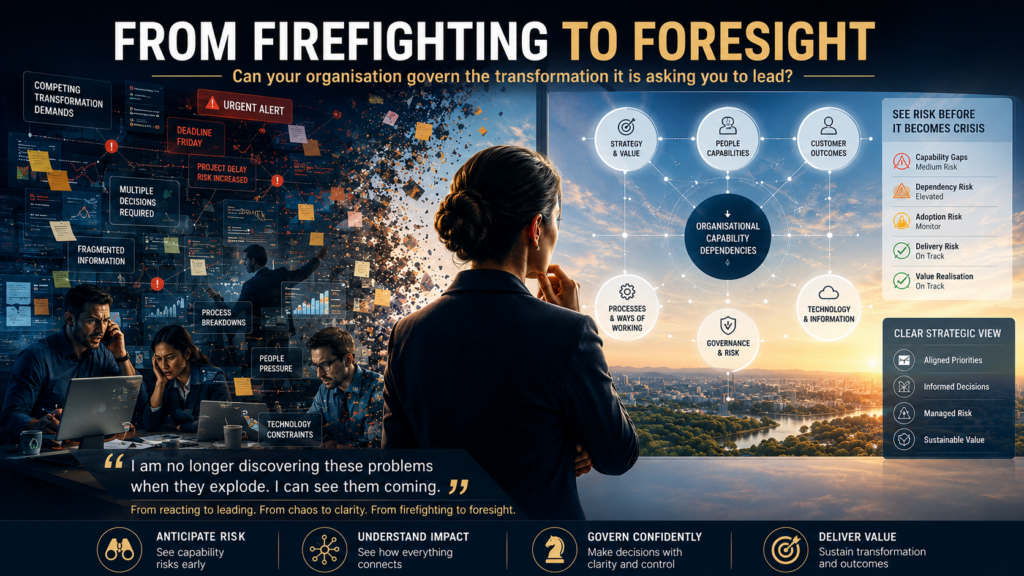
From Firefighting to Foresight
This is where I think the CIO’s role can change.
The answer isn’t for the CIO to take responsibility for organisational development.
They shouldn’t.
The answer isn’t for the CIO to become the organisation’s Chief Change Officer.
They shouldn’t.
The opportunity is to give the CIO visibility.
Before a transformation begins—or early enough in the transformation to do something about it—identify:
- What organisational capabilities will the transformation require?
- What capabilities exist today?
- Where are the significant gaps?
- Which gaps represent material transformation risks?
- Who owns those risks?
- How will those capabilities develop alongside the transformation?
- How will the executive team know that they are improving?
That is a governance conversation.
And it changes the CIO’s position.
Instead of continually discovering organisational constraints through project problems, the CIO can bring those constraints into the transformation conversation before they become problems.
That is the shift from:
Firefighting → Foresight.
Burnout May Be a Signal
This is why I’ve become increasingly uncomfortable with the idea that CIO burnout can be addressed simply by helping CIOs cope better.
- Of course wellbeing matters.
- Of course workload matters.
- Of course CIOs need support.
But if an organisation repeatedly asks an executive to compensate for capability gaps that have never been identified or governed, the problem isn’t simply personal resilience.
It is systemic.
And the answer needs to be systemic too.
Perhaps sometimes burnout is telling us something about the organisation.
Not:
- “Our CIO can’t cope.”
But:
- “Our organisation is asking our CIO to compensate for risks we haven’t properly governed.”
That is a much more useful conversation.
What If We Governed Capability Alongside Technology?
Imagine:
- that transformation governance included a capability baseline alongside the technology baseline.
- knowing before a major AI deployment that a particular business unit is operating in a highly habituated environment.
- knowing that leadership alignment is weak before the programme reaches implementation.
- knowing that the organisation’s operating model isn’t capable of supporting the future state.
- knowing that change saturation is already putting critical teams under strain.
Now those aren’t surprises.
They are risks.
And risks can be discussed.
- And addressed.
The CIO doesn’t have to own the solution.
But the organisation can no longer claim that it didn’t know.
The Question I Think We Should Be Asking
For me, this brings CIO wellbeing and transformation governance into the same conversation.
The question isn’t simply:
- “How do we prevent CIO burnout?”
Nor is it:
- “How do we make our CIO more resilient?”
The bigger question is:
- “How ready is our organisation to govern the transformation we are asking our CIO to lead?”
Because if the organisation cannot see the capability risks that sit underneath its transformation, the CIO will continue to discover those risks the hard way.
- Through delays.
- Through resistance.
- Through escalating costs.
- Through failed adoption.
- Through missed benefits.
- Through increasingly difficult executive conversations.
And sometimes through personal exhaustion.
I think we can do better.
Beyond Burnout
This is why I’ve called my white paper Beyond Burnout.
Not because burnout isn’t important.
It is.
But because I don’t think we should stop at the symptom.
We need to understand what is creating the pressure.
If organisational capability risk is one of the factors threatening transformation value, then it needs to become visible within transformation governance.
And if we can make it visible earlier, we can potentially do something about it earlier.
That is better for the transformation.
Better for the investment.
Better for the organisation.
And, importantly, better for the CIO leading the journey.
Perhaps the way to protect the CIO isn’t simply to give them less responsibility.
Perhaps it’s to give them better foresight.
A question for CIOs
How ready is your organisation to govern the transformation it is asking you to lead?
And if you don’t know the answer, perhaps that is itself worth investigating.
I’ve explored this thinking further in my white paper “Beyond Burnout: The Hidden Cost of Capability Misalignment.” You can download it HERE.
I’d genuinely value your perspective.
Have you ever found yourself personally compensating for an organisational capability gap because the transformation simply had to keep moving?