

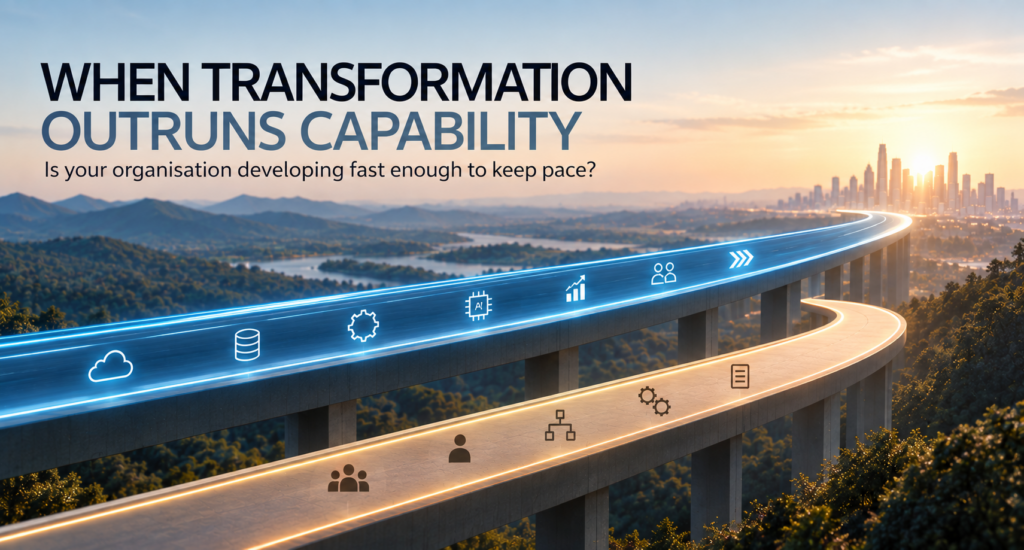
There is something rather strange about the way we approach transformation.
We spend enormous amounts of time defining what the organisation needs to become.
- We define the strategy.
- We select the technology.
- We redesign processes.
- We build the business case.
- We establish the programme structure.
- We appoint sponsors.
- We create governance forums.
And then, somewhere along the way, we seem to assume that the organisation will become capable of operating in the new way.
But what if it doesn’t?
Or, more importantly, what if it doesn’t quickly enough?
That question has been sitting at the back of my mind since I started looking more closely at organisational capability and transformation.
Because if transformation requires an organisation to operate differently in the future, then it must also require the organisation to develop the capabilities needed to operate that way.
And that sounds obvious.
Until you look at how transformations actually work.
Transformation doesn’t just implement something new
A transformation programme is usually described in terms of what it is delivering.
- A new ERP.
- A new digital customer experience.
- An AI capability.
- A new operating model.
- A data platform.
- A new way of working.
But underneath every one of those initiatives is another question:
What will the organisation need to be capable of doing differently when this transformation is complete?
That is a very different question.
And it changes the conversation.
Because a new technology platform might be technically ready.
- The implementation team might have delivered everything in the project plan.
- The training might have been completed.
- The system might even go live successfully.
But if the organisation doesn’t have the capability required to use that technology effectively, make the decisions it enables, change the associated processes, manage the new ways of working and sustain them over time, have we really transformed?
Or have we simply implemented something new?
That distinction matters enormously.
The research and thinking behind UDT has been central to my own exploration of this question.
One of the ideas that has stayed with me is:
An organisation cannot sustainably operate beyond the level of its current organisational capability.
Every transformation therefore creates a developmental challenge.
The future state requires capabilities that may not yet exist at the required level.
And those capabilities have to develop.
But capability development is not the same as training
This is where I think we can easily fall into another transformation trap.
When we discover a capability gap, the instinct is often:
- “We need training.”
Sometimes we do.
But organisational capability is much bigger than individual skills.
The capability required to deliver a transformation may involve changes in:
- leadership;
- decision-making;
- organisational structure;
- business processes;
- ways of working;
- systems;
- information;
- customer capability;
- skills and capacity;
- culture;
- governance;
These elements interact.
Changing one without addressing the others may not produce the capability the transformation actually requires.
And this is one of the reasons I find the organisational capability perspective so interesting.
It asks us to stop thinking about capability as something we “fix” in a department.
Instead, we begin to ask:
- What does the organisation need to be capable of doing differently?
And then:
- What needs to change for that capability to exist?
The timing problem
There is another issue that I think deserves much more attention.
When does the organisation need the capability?
- Not eventually.
- Not at some point after the transformation.
- Not when the project team has finished.
When does the transformation actually depend on it?
Imagine a transformation introduces a radically different operating model.
- The new structure is designed.
- The technology is configured.
- The new processes are documented.
But the leadership team isn’t yet comfortable making decisions in the new model.
- Business units continue operating according to the old boundaries and processes.
- People continue escalating decisions through the old hierarchy.
- Performance measures still reward the old behaviours.
- The organisation hasn’t developed the capability required to operate the new model.
That isn’t simply a “change management issue”.
It is a transformation risk.
And the timing matters.
- If the capability can be developed before it is required, the risk may be manageable.
- If it can only be developed after the transformation depends upon it, the risk is very different.
This is why I increasingly think that capability needs to be viewed dynamically.
Not simply:
- Where are we now?
But:
- Where do we need to be, and when do we need to get there?
This changes the conversation about Transformation Readiness
Last week we explored the idea that capability can be measured.
But measurement is only useful if it changes what we do.
And this is where the distinction between maturity and readiness becomes important.
An organisation doesn’t necessarily need to be highly mature in every capability before it can transform.
That would be unrealistic.
The more useful question is whether the organisation is sufficiently capable for the transformation it is undertaking, at the point at which that capability is required.
A capability gap is therefore not automatically a transformation risk.
It becomes a risk when the gap matters to the transformation and cannot be closed quickly enough—or is likely to compromise the intended outcomes.
That gives us a very different way of thinking about readiness.
Not:
- “Are we a mature organisation?”
But:
- “Can we develop the capabilities this transformation requires quickly enough to support the outcomes we expect?”
That is a much more useful executive question.
So, who is responsible for developing the capability?
This is where I think the CIO conversation becomes particularly interesting.
Because the answer isn’t:
The CIO.
And it shouldn’t be.
The CIO shouldn’t suddenly become responsible for organisational development simply because technology is at the centre of the transformation.
Capability development belongs across the organisation.
- HR may have a role.
- Operations may have a role.
- Finance may have a role.
- Business leadership certainly has a role.
- Technology has a role.
And depending on the transformation, there may be many others.
The important point is that nobody owns organisational capability in isolation.
But that doesn’t mean nobody needs to govern it.
That distinction is becoming increasingly important in my thinking.
The CIO’s role is not to develop every capability required by a transformation.
The CIO’s role is to ensure that capability constraints that could threaten transformation outcomes become visible.
They can then be assessed, communicated, assigned to the appropriate business owners, monitored and escalated where necessary.
That is a governance role.
And it is very different from taking ownership of Organisation Development.
The Organisation Capability Alignment Method we’ve been developing is based around exactly this distinction: define the transformation, understand its capability implications, establish capability governance, lead collaborative transformation, build capability continuously and sustain Transformation Readiness.
Capability development needs to run alongside the transformation
Perhaps the biggest shift is this.
We have traditionally tended to think of transformation as:
Design → Build → Implement → Adopt
with organisational development somewhere alongside it.
I think we need to start thinking differently.
The organisation itself is part of what is being transformed.
Which means:
Transformation development and organisational capability development need to move together.
- The technology develops.
- The processes develop.
- The operating model develops.
- The people develop.
- Leadership develops.
- Decision-making develops.
- Governance develops.
- The organisation develops.
And, as the transformation evolves, the capability required may evolve with it.
This is why capability development cannot simply be a once-off intervention.
That, to me, is a fundamentally different way of thinking about transformation.
And this is where governance becomes important
Once we start thinking about capability development this way, another question naturally follows.
How do we know whether it is keeping pace?
Because the transformation has milestones.
- It has budgets.
- It has delivery measures.
- It has risk registers.
- It has benefits measures.
- It has executive reporting.
But what tells the executive team whether the organisation itself is becoming capable of delivering the transformation?
That is the question I keep coming back to.
Because if the capability isn’t developing quickly enough, waiting until the transformation starts failing is a very expensive way of finding out.
The purpose of capability governance isn’t to create another committee or another layer of bureaucracy.
It is to make sure that organisational capability becomes visible enough to be governed.
The objective is not to make the CIO responsible for fixing everything.
Quite the opposite.
It is to make sure the right people know what capability is required, where the gaps are, who needs to act, and whether the organisation is developing quickly enough to support the transformation.
Perhaps this is the real meaning of Transformation Readiness
I’ve started to think that Transformation Readiness isn’t really something an organisation either “has” or “doesn’t have”.
It is a relationship.
A relationship between:
- what the transformation requires
and
- what the organisation is capable of doing.
And that relationship changes.
- The transformation moves.
- The organisation develops.
- New capability requirements emerge.
- Existing capability gaps close.
- Other gaps appear.
The organisation may become more ready—or less ready—as the transformation progresses.
That means Transformation Readiness needs to be understood as something that can be developed, monitored and governed over time.
Not a box to tick before the project starts.
The question I think we should be asking
So, can organisational capability be developed?
Absolutely.
But I think the more important question is:
Can it be developed quickly enough, deliberately enough and in the right areas to keep pace with the transformation?
Because a transformation doesn’t wait.
- The business case doesn’t wait.
- The technology doesn’t wait.
- The market doesn’t wait.
- And increasingly, neither does AI.
If the organisation needs to become capable of doing something fundamentally different in order to realise the value of a transformation, then capability development isn’t something that happens after transformation.
It is part of the transformation.
And perhaps that is where the conversation about Transformation Readiness needs to go next.
Transformation Readiness
Transformation Readiness is not about asking whether the technology is ready.
It’s about asking whether the organisation is capable of delivering the business value the transformation is intended to create.
So the question becomes:
- How ready is your organisation for the transformation it is undertaking?
And perhaps an even more useful question:
- Is the organisation’s capability developing fast enough to keep pace with the transformation?
That is a question worth putting on the transformation dashboard.