

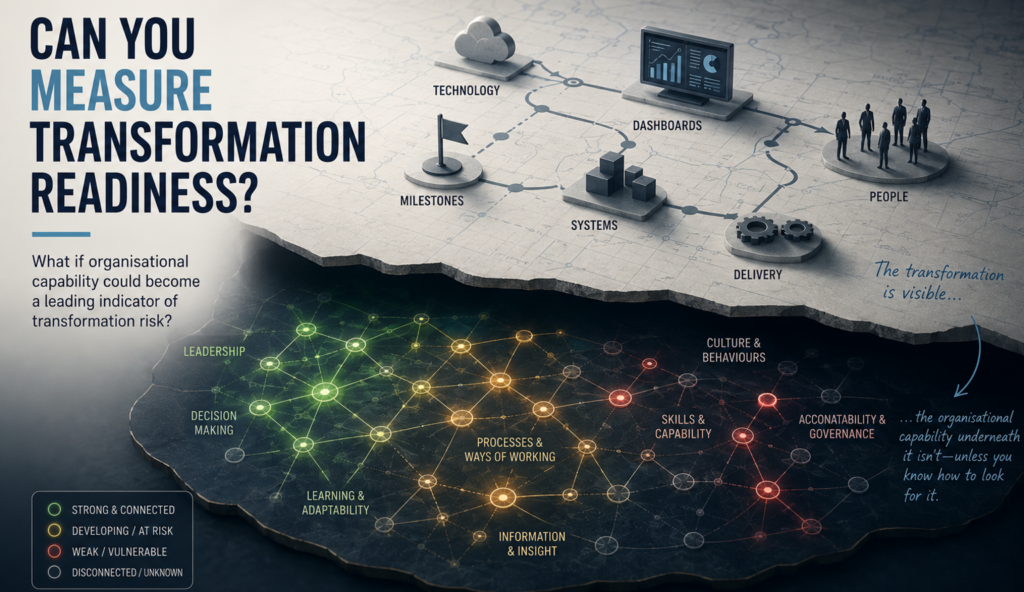
I’ve been asking a lot of questions about transformation over the past few weeks.
- Why do transformations struggle to deliver the value promised?
- Why are CIOs often carrying responsibility for outcomes that depend on things outside their direct control?
- What happens when the organisation doesn’t have the capability required by the transformation?
And, more recently, I’ve been exploring the research behind Unitary Development Theory (UDT) and what it tells us about organisational development.
But eventually, we arrive at a very practical question.
Can organisational capability actually be measured?
Because if it can’t, we have a problem.
- We can talk about organisational readiness.
- We can talk about culture.
- We can talk about leadership.
- We can talk about change capability.
- We can talk about whether people are “ready”.
But if all we can do is describe these things subjectively, how useful are they when we’re trying to govern a transformation involving millions—or tens or hundreds of millions—of investment?
This is where the Digital Maturity Index (DMI) becomes particularly interesting to me.
Not because I believe organisations need another maturity model.
But because, as a diagnostic tool, it potentially gives us something transformation governance has been missing:
- a way of making organisational capability visible.
We’ve Become Very Good at Measuring the Transformation
Think about the information that typically appears on a transformation dashboard.
- Budget.
- Schedule.
- Milestones.
- Scope.
- Dependencies.
- Technical delivery.
- Issues.
- Risks.
- Benefits.
- Adoption.
All useful.
And increasingly sophisticated.
But there is often another question sitting underneath all of those measures:
Is the organisation developing the capability required to make the transformation work?
That’s harder to answer.
We might say:
- “Leadership is aligned.”
- “People are engaged.”
- “The organisation is ready.”
- “Change management is on track.”
But what exactly does that mean?
And how would we know?
This matters because organisational capability isn’t simply one thing.
It is an interconnected system.
- Leadership influences decision-making.
- Decision-making influences execution.
- Processes influence how people work.
- Technology changes the demands placed on people and processes.
- Operating models change accountabilities and relationships.
New strategies require different capabilities.
The organisation’s ability to absorb one change can influence its ability to absorb the next.
So, measuring a single “readiness score” may not tell us very much.
What we need to understand is what the organisation is capable of doing, where it is capable of doing it, and whether that capability is sufficient for the transformation being undertaken.
The Difference Between “Maturity” and Readiness
This is an important distinction.
An organisation doesn’t need to be “highly mature” to undertake every transformation.
A business may be perfectly capable of implementing a relatively contained technology change.
The same organisation may struggle with a transformation that fundamentally changes its operating model, decision-making, customer proposition or business model.
So, I don’t think the useful question is:
- “How mature is this organisation?”
The more useful question is:
- “What level of organisational capability does this particular transformation require, and does the organisation currently have it?”
That is what makes the idea of Transformation Readiness different from a generic maturity assessment.
Readiness is relative to the transformation.
The organisation’s current capability is one side of the equation.
The capability required by the future state is the other.
The potential risk sits in the gap.
This Is Where the DMI Becomes Interesting
The Digital Maturity Index (DMI) is the diagnostic tool associated with UDT.
The purpose isn’t simply to give an organisation a number.
A number on its own isn’t particularly useful.
What becomes useful is being able to use measurement to understand the organisation’s current developmental position and then consider that against what the transformation is asking the organisation to become.
That creates a different conversation.
Instead of:
- “Are our people ready?”
we can ask:
- “What organisational capabilities will this transformation require?”
And then:
- “Where are we now?”
And:
- “Where are the material gaps?”
And finally:
- “What does that gap mean for our transformation?”
That last question is the one I find particularly important.
Because the purpose of measuring capability isn’t to produce an interesting organisational profile.
It is to make transformation risk visible.
From Measurement to Risk
This is where I think organisational capability belongs in the transformation governance conversation.
Imagine a transformation governance meeting.
- The programme is on budget.
- The technology is being delivered.
- The major milestones are green.
- The risks are being managed.
But the organisation’s current capability is significantly below what the future operating model requires.
Where does that appear?
- Perhaps there is a change-management workstream.
- Perhaps HR has a capability-development programme.
- Perhaps leadership has been briefed.
But is the capability gap itself visible as a material transformation risk?
And is anyone monitoring whether that gap is closing quickly enough?
That’s a very different question.
Once we can measure capability, we can begin to treat it differently.
It becomes something that can be:
identified → assessed → prioritised → assigned → developed → monitored
That is much closer to governance than traditional “change management”.
Why This Matters to the CIO
This brings us back to the dilemma I explored earlier in the series.
CIOs don’t want to become responsible for organisational development.
And they shouldn’t.
But CIOs are increasingly responsible for transformation outcomes.
So, they need visibility of the organisational factors that could put those outcomes at risk.
This is where I think measurement changes the conversation.
The CIO doesn’t have to say:
- “The organisation isn’t ready.”
That is a broad and potentially confrontational statement.
Instead, they can ask:
- “What organisational capabilities does this transformation require?”
- “What evidence do we have of our current capability?”
- “Where are the material gaps?”
- “What risks do those gaps create?”
- “Who is responsible for developing those capabilities?”
- “When do we expect them to be sufficiently developed?”
- “How will we know?”
Those are much more useful executive questions.
And they create a bridge between the CIO, the executive team and OD.
It Also Changes the Role of OD
This is another reason I find the measurement question so interesting.
OD has traditionally been brought into transformation after many of the important decisions have already been made.
- The strategy has been agreed.
- The technology selected.
- The programme approved.
- The operating model designed.
And then someone asks:
- “How are we going to manage the people side of this?”
By that point, the organisation may already have accumulated significant capability risk.
A measurable view of organisational capability potentially allows OD to move upstream.
Instead of simply reporting:
- “We’ve trained 80% of the managers.”
OD can potentially contribute to a much more strategic conversation:
“These are the capabilities the future operating model requires. This is our current position. These are the material gaps. This is what we are doing to develop them, and this is the expected trajectory.”
That is a very different role.
And it is much closer to Organisation Capability Governance.
The King V Connection
This is also where the timing becomes interesting.
King V places considerable emphasis on outcomes, value creation, risk governance, technology and information, and assurance.
That raises an important question for transformation governance.
If the organisation is expected to understand and govern the risks that could affect sustainable value creation, shouldn’t organisational capability risk be visible where it is material to the transformation?
I’m not suggesting that a maturity score suddenly becomes a governance requirement.
It doesn’t.
The point is much simpler.
Good governance requires good information.
If organisational capability is a material determinant of whether a transformation can deliver its intended outcome, then having objective information about that capability potentially gives the executive team something much better to govern with than assumptions.
And this is where I think the combination of UDT, DMI and transformation governance becomes particularly interesting.
- Not as an HR exercise.
- Not as another maturity assessment.
But as a way of making a previously difficult-to-see category of transformation risk more visible.
Measurement Isn’t Prediction
I want to make an important distinction here.
The title of this week’s article asks whether the DMI can predict transformation success.
I’m deliberately being careful with that word.
I don’t think we should claim that a DMI assessment can simply look at an organisation and predict whether its transformation will succeed.
That would be far too simplistic.
What I do think is worth exploring is whether measured organisational capability can provide meaningful leading indicators of transformation risk.
That’s a much more interesting proposition.
If we know what capabilities a transformation requires, and we can measure the organisation’s current capability, we have the beginnings of a way to identify where the transformation may be vulnerable.
And if we measure again as the transformation progresses, we can potentially see whether those capabilities are developing.
That gives us something transformation governance often lacks:
a view of whether the organisation itself is keeping pace with the transformation.
From Lag Indicators to Lead Indicators
Most transformation governance measures tell us what has already happened.
- The budget has been exceeded.
- The milestone has been missed.
- Adoption is below target.
- Benefits haven’t materialised.
Those are important measures.
But by the time they turn red, the problem may already be expensive.
What if we could identify some of the organisational conditions that are likely to contribute to those outcomes earlier?
For example:
- A capability gap.
- A leadership-development gap.
- A decision-making constraint.
- An operating-model mismatch.
- An inability to absorb further change.
- A lack of capability in a critical business function.
These aren’t necessarily failures.
They’re signals.
And signals are useful because they give leaders an opportunity to act before the consequence becomes visible in the programme metrics.
That’s the shift from firefighting to foresight.
The AI Question
This becomes even more interesting when we consider AI.
AI transformation is likely to place demands on organisations that go well beyond technology.
Organisations may need to rethink how decisions are made.
- How work is designed.
- How knowledge is shared.
- How people interact with technology.
- How managers lead.
- How quickly teams adapt.
- How experimentation happens.
- How risk is managed.
So perhaps one of the questions we should be asking before a major AI investment is:
What organisational capabilities will this AI transformation require?
And then:
Do we currently have them?
- This is one of the questions I am increasingly interested in exploring through UDT and DMI.
Not assuming that there is a particular maturity level at which an organisation suddenly becomes “AI ready”.
But asking whether there is a measurable relationship between organisational maturity, the complexity of the transformation being undertaken, and the ability to realise value from it.
That feels like a research question worth investigating.
The Real Value of Measurement
Ultimately, I don’t think the value of the DMI is the assessment itself.
The value is what happens because we know.
- If we know where capability gaps exist, we can make better decisions.
- If we know which gaps matter most to the transformation, we can prioritise them.
- If we know who needs to address them, we can allocate responsibility.
- If we monitor them, we can see whether development is keeping pace.
And if the information is brought into transformation governance, the executive team can make better decisions about risk, sequencing, investment and value realisation.
That is where measurement becomes strategic.
Not because a score tells us what to do.
But because better evidence allows better governance.
Transformation Readiness Is Becoming a Different Conversation
When I started this journey, I thought the question was largely about transformation failure.
- Then I started looking more closely at the CIO’s role.
- Then at organisational capability.
- Then at UDT.
Now I’m increasingly interested in the relationship between measurement and governance.
Because if organisational capability is one of the conditions required for transformation success, perhaps it shouldn’t remain an invisible assumption.
- Perhaps it should be measured.
- Perhaps it should be monitored.
And perhaps, where it represents material risk, it should become part of the transformation governance conversation.
That leads me back to the definition of Transformation Readiness that is becoming central to my thinking:
Transformation Readiness is not about asking whether the technology is ready. It’s about asking whether the organisation is capable of delivering the business value the transformation is intended to create.
So how do you know whether your organisation is Transformation Ready?
That’s the question I’m now exploring with a small number of organisations undertaking transformation.
I’m looking for three founding Design Partners to help test this approach in real transformation environments.
The purpose isn’t simply to produce another organisational assessment.
It is to explore whether we can identify transformation-specific capability risks early enough to make them useful within transformation governance—and whether tracking capability development alongside the transformation can provide meaningful leading indicators of risk and value realisation.
If you’re undertaking a significant transformation and would like to be one of the organisations helping shape this emerging approach, I’d be very happy to have a conversation.