

From Transformation Ambition
to
Business Value Realisation
Transformation Readiness
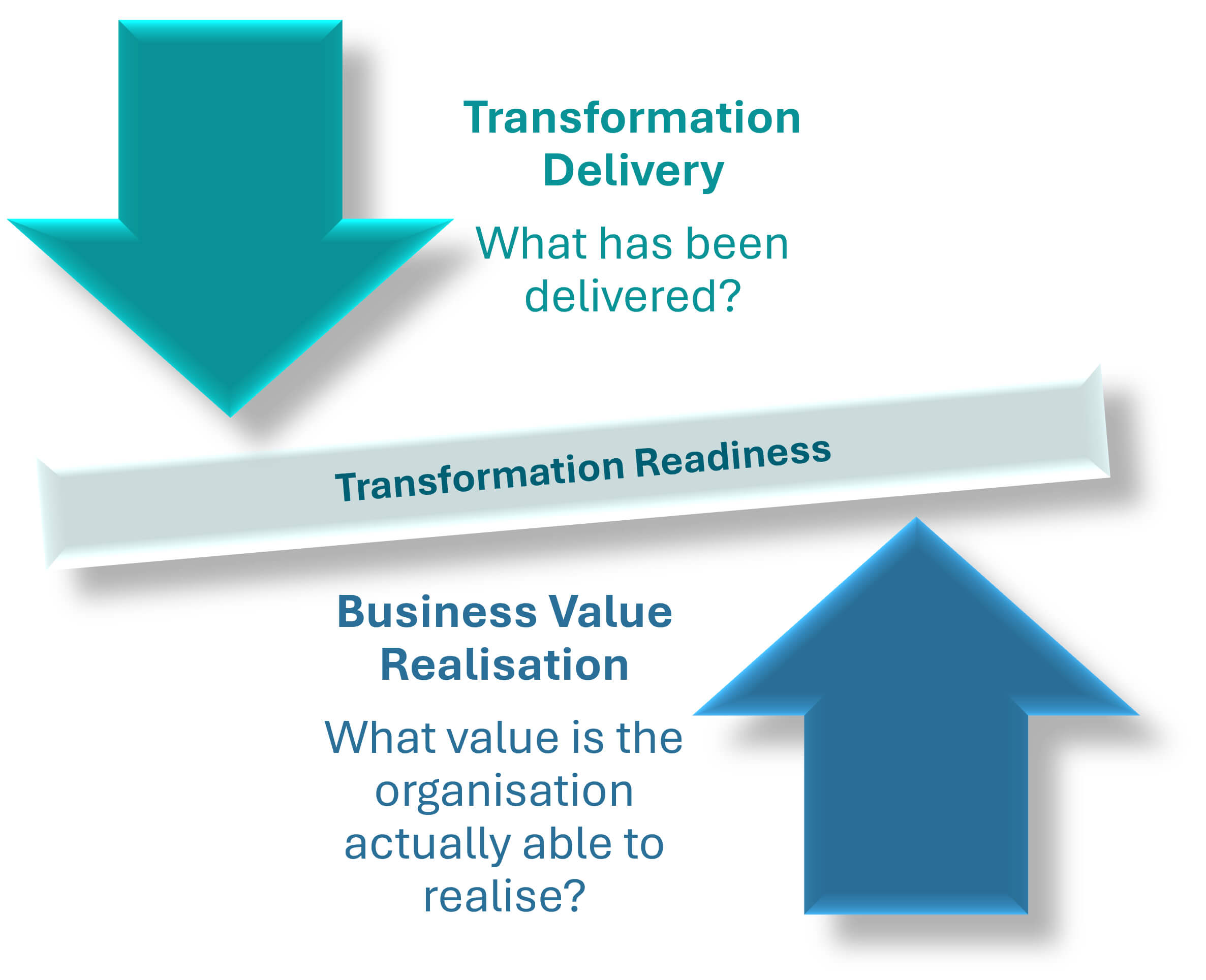
Transformations can be delivered … but
Organisation Capabilities determine business value realisation
“Transformation Readiness” is the discipline of identifying the organisation capabilities a transformation depends on, understanding the gaps, establishing ownership and accountability for those gaps, bringing material risks into transformation governance, and tracking their development through to business value realisation.
Transformation Readiness: Readiness for What?
Change asks an organisation to DO something different. Transformation asks an organisation to BE something different.

A transformation may change how an organisation operates, serves its customers, makes decisions, manages its data or creates value. Transformations in different areas of the business have different objectives—and each depends on its own specific set of organisation capabilities to realise the intended business value.
The question is: Does the organisation have the capabilities it needs to make the transformation work?
Transformation Readiness Answers that Question
Transformation Readiness examines the capabilities needed by a specific transformation and compares them with the organisation’s current capabilities.
This identifies the gaps between what the transformation requires and what the organisation can currently do. It helps establish which gaps matter to the transformation, where accountability sits, and what needs to happen to address them.
The result is a clearer understanding of the capabilities the organisation needs to develop and the actions required to support business value realisation.
Are you Measuring Transformation Delivery — or Value Realisation?
If your transformation dashboard tells you that the programme is on time, within budget and delivering its milestones, what tells you whether the organisation is actually becoming capable of realising the intended value?
| Transformation Delivery | Business Value Realisation |
| Are we delivering the programme? | Are we realising the intended value? |
| Are milestones being achieved? | Are the expected outcomes emerging? |
| Is the technology being implemented? | Is the organisation capable of using it effectively? |
| Is the transformation on track? | Is the organisation becoming capable of sustaining the change? |
Business value realisation provides another lens through which transformation decisions can be made.
When Capability Gaps Become Transformation Risks
But, not every capability gap threatens a transformation. Gaps become Organisation Capability Risks (OCR) when the capabilities needed to adopt the changes, adapt to the new environment and sustain the intended business value are absent or insufficient.
Transformation Readiness helps identify and clarify these risks, establish their implications for transformation outcomes, and provide a roadmap for closing the gaps.
Organisation Capability Risk: Part of Transformation Governance
Identifying a capability risk is only the beginning. If the risk could materially affect transformation outcomes, it needs to be recognised as an item within transformation governance.
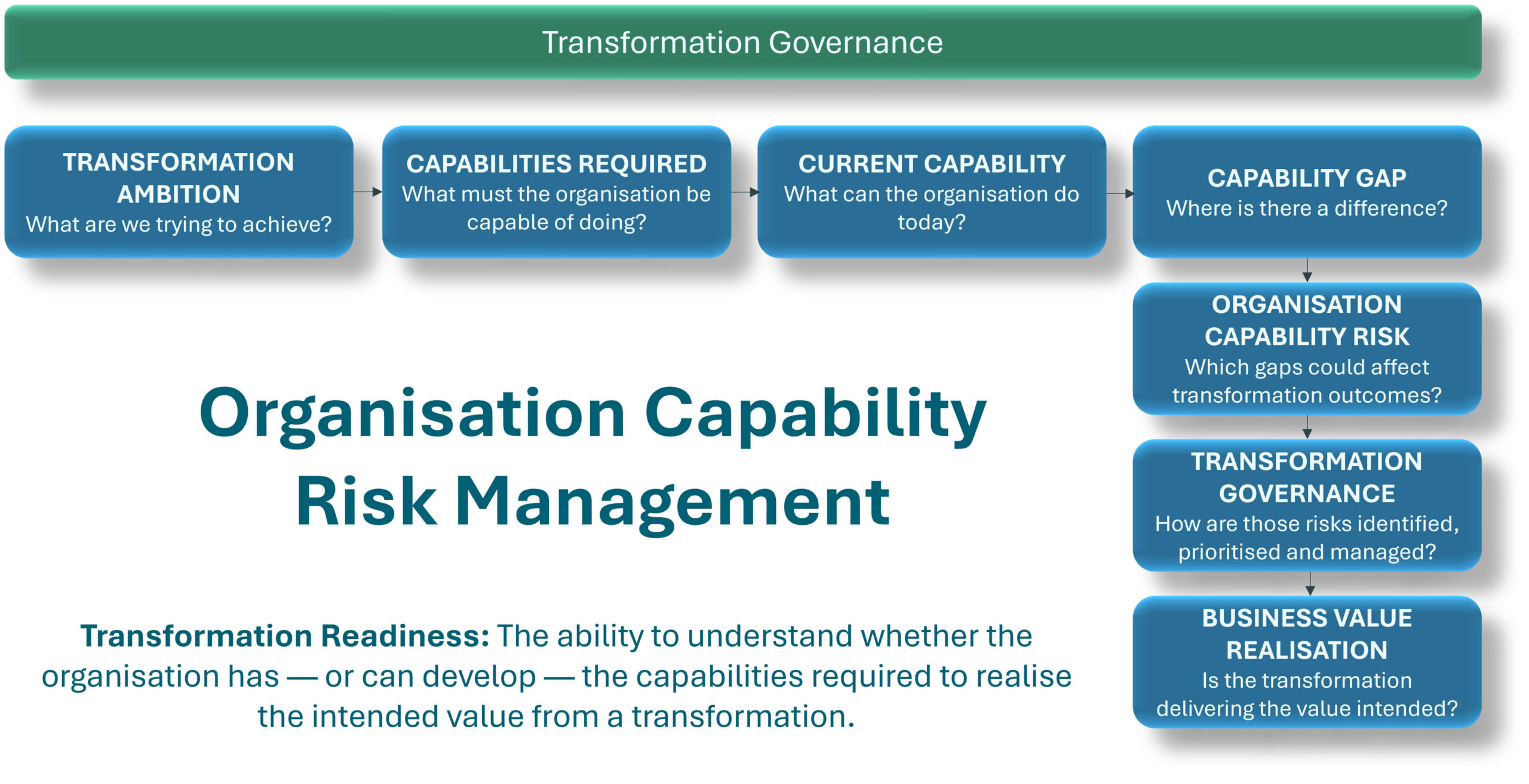
This makes the risk visible, establishes ownership and accountability for addressing it, and allows progress in developing the required capability to be monitored alongside transformation delivery.
The objective is to ensure that capability gaps do not remain hidden until they become costly problems—and that progress towards the capabilities needed for business value realisation remains visible throughout the transformation.
Transformation Readiness Use Cases
Transformation Readiness is specific to a transformation and its intended outcomes. Depending on the situation, the assessment may inform an investment decision, shape the transformation plan, identify capability gaps and their owners, or track whether the organisation is developing the capabilities needed to realise value.
| Use Case | Description |
| Procurement Before committing to a major purchase | An organisation is evaluating a significant product or service investment. Its readiness is assessed during the bid process to determine whether it has the organisational capabilities required to implement, adopt and use the solution effectively. Timing: During the procurement and bid evaluation process, before the final investment decision. Key question: Can we realise the intended value from this investment, or do we need to address capability gaps first? |
| IT Modernisation Moving to a new architecture | Once the intended architecture has been defined, the organisation assesses the capabilities required to make the transition and operate effectively in the new environment. This includes data management, business processes, skills, systems, governance and the operating model. Timing: After the intended architecture has been decided, during transition planning, and at key stages as the new environment is implemented. Key question: What must change in the organisation—not just in its technology—for the new architecture to deliver its intended value? |
| Business Model Transformation Moving towards a new way of operating | At the outset, the organisation assesses its current capabilities against those required by the proposed business model. This establishes what it can adopt and sustain now, which gaps need to be addressed, and how capabilities can develop progressively towards the desired state and business value. Timing: At the beginning of the transformation, with reassessments as the business model and required capabilities evolve. Key question: What can the organisation realistically achieve today, and what capabilities must evolve to reach its longer-term ambition? |
| ERP Implementation Preparing the business, not just the system | An organisation implementing a new ERP system assesses whether its processes, data, roles, decision-making and cross-functional coordination can support the new way of working. This identifies capability gaps that could undermine implementation or prevent the expected benefits from being realised. Timing: During implementation planning and throughout the implementation as the system and associated ways of working are developed. Key question: Will the organisation be able to operate effectively with the new system and realise the business benefits it was intended to deliver? |
| AI Adoption Turning AI investment into business value | Before introducing AI into business operations, the organisation assesses whether its data management, processes, governance, security, skills and decision-making can support the intended use cases. As adoption progresses, readiness is reassessed to identify what must change for AI to deliver sustained value. Timing: Before significant AI investment, before deployment of specific use cases, and as AI adoption expands. Key question: Does the organisation have the capabilities needed to use AI effectively and safely and translate its potential into measurable business value? |
| Supply Chain Transformation Building a more responsive operation | An organisation is redesigning its supply chain to improve resilience, visibility or efficiency. Transformation Readiness identifies whether planning, data sharing, supplier relationships, accountability and operational decision-making can support the intended operating model. Timing: During transformation design, before major changes are implemented, and as the new operating model takes shape. Key question: Can the organisation’s people, processes, data and relationships support the supply chain performance the transformation is intended to achieve? |
| Merger or Acquisition Integration Making the combined organisation work | Following a merger or acquisition, Transformation Readiness examines whether the combined organisation can operate as intended. It identifies gaps in governance, roles, processes, systems, data, leadership and ways of working that could prevent expected synergies from materialising. Timing: During integration planning and throughout the integration as the combined organisation takes shape. Key question: What organisational capabilities must be in place for the combined organisation to realise the strategic and financial benefits of the deal? |
| Business Expansion Scaling without losing control | An organisation plans to enter new markets, expand geographically or substantially increase its revenue without a similar increase in operations. Transformation Readiness determines whether its leadership, operating model, processes, systems and management capabilities can sustain the planned growth—and what needs to develop as the organisation scales. Timing: Before expansion begins and at key growth milestones as the organisation’s demands and operating complexity increase. Key question: Can the organisation sustain the planned growth with its current capabilities, and what must change to realise the intended business value? |
These are just a handful of the possible areas where knowing you have the organisation capabilities to deliver the transformation can save time, money, frustration and reputation.
If you have a Use Case that you would like to discuss with us, set up time in our diary for a “no-charge” discussion.
To find out more, please complete the form below and we will be in touch directly.