
Transformation Readiness
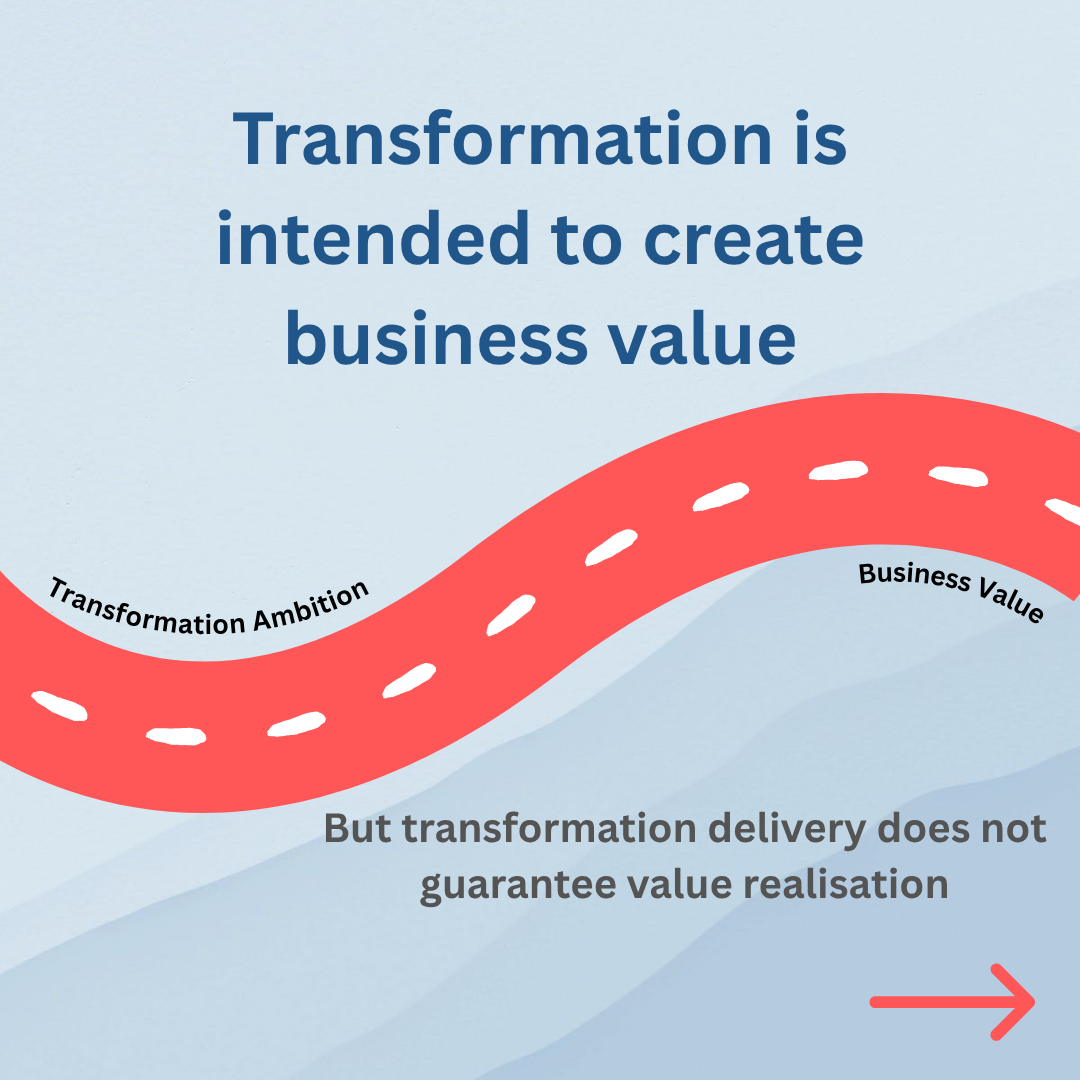
The ability to realise the business value that transformation is intended to deliver.
Book a Free 30-min Consult on the “The Impact of Transformation Unreadiness”
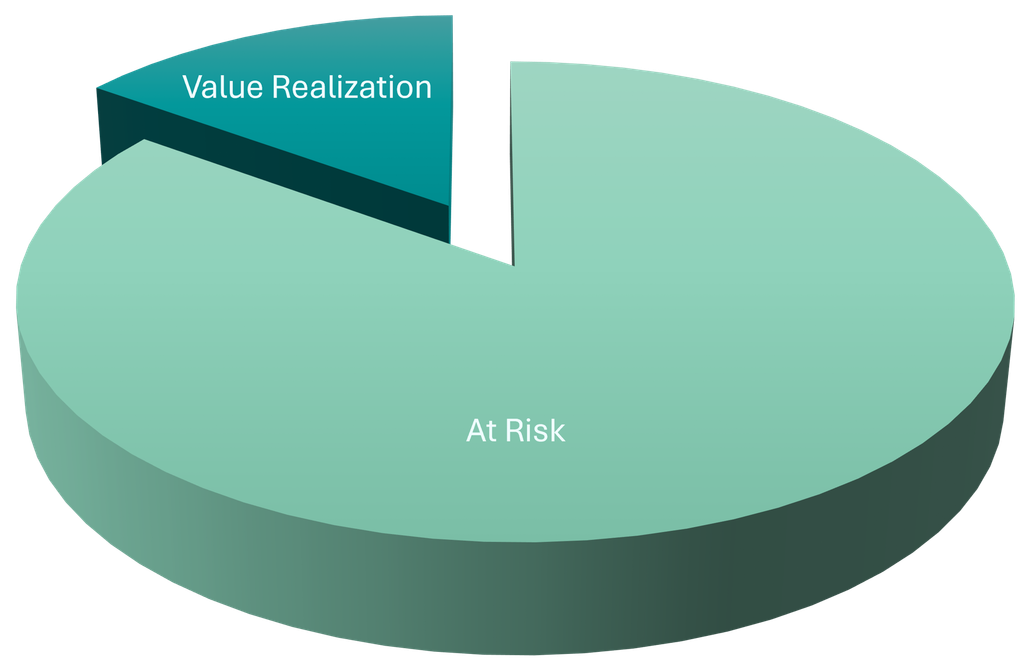
Up to $0.85 cents of every $1.00 invested in transformation may be at risk.
Research consistently shows that many transformations fail to realise their intended business outcomes – somewhere between 70% and 85% in fact.
And even transformations considered successful often capture only part of the value available.
With organisations investing millions in digital, technology and AI transformation, the value at risk is significant.
So, what determines whether the transformation actually realises value?
Organisation Capability Matters.
Many organisations invest heavily in transformation without fully understanding whether they have the capabilities required to realise its intended value.
Research increasingly recognises Organisational Capability as a major factor in transformation success.
Organisation Capabilities such as strategy, workplace, offering, customer intimacy, operations and technology influence an organisation’s ability to turn transformation into business value.
Organization Capabilities
“The intangible, strategic assets that an organisation draws from to get work done, execute its business strategy, and satisfy its customers.
“They can include expertise, activities, information, knowledge, procedures, processes, skills, systems, technologies, or unique adaptive features.”
Source: AIHR”
But capability is often treated as something to address once the transformation is being implemented.
We See it Differently
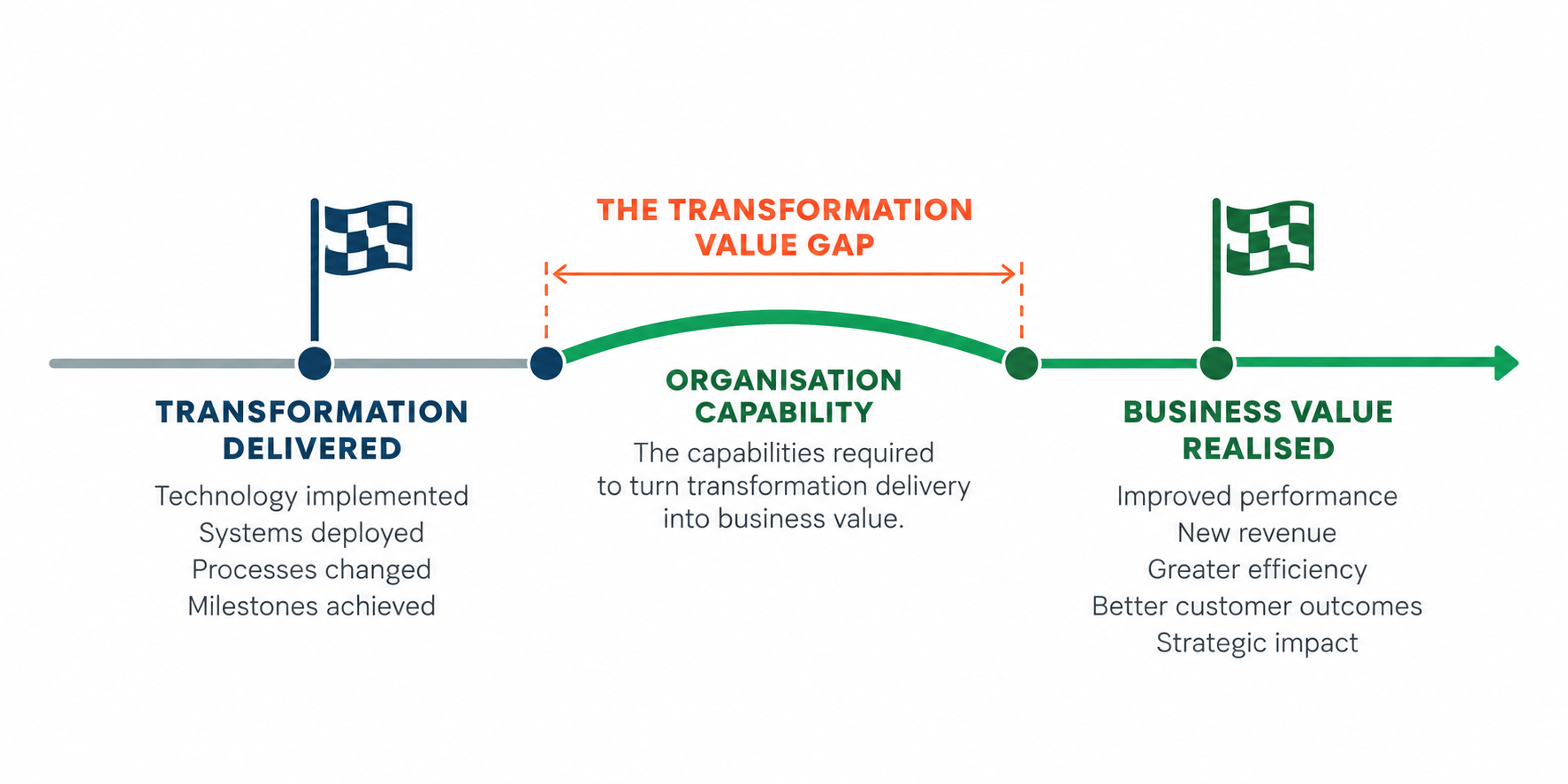
Every transformation needs to create the capabilities required
to realise the intended business value.
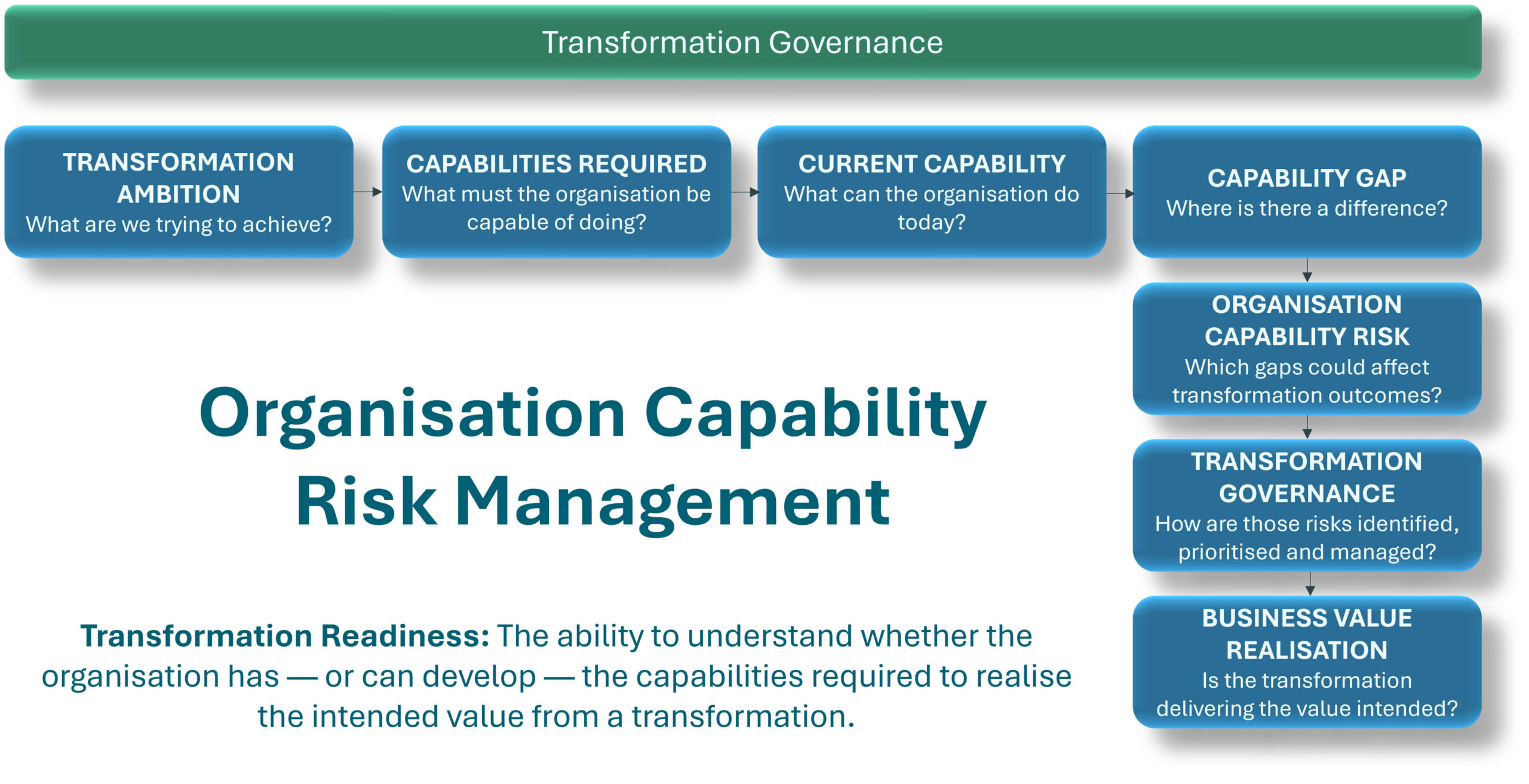
The question is: what capabilities are needed to realise the transformation’s intended value — and does the organisation have them?
Not simply:
But:
Can we deliver the transformation?
Can the organisation realise the value the transformation is designed to create?
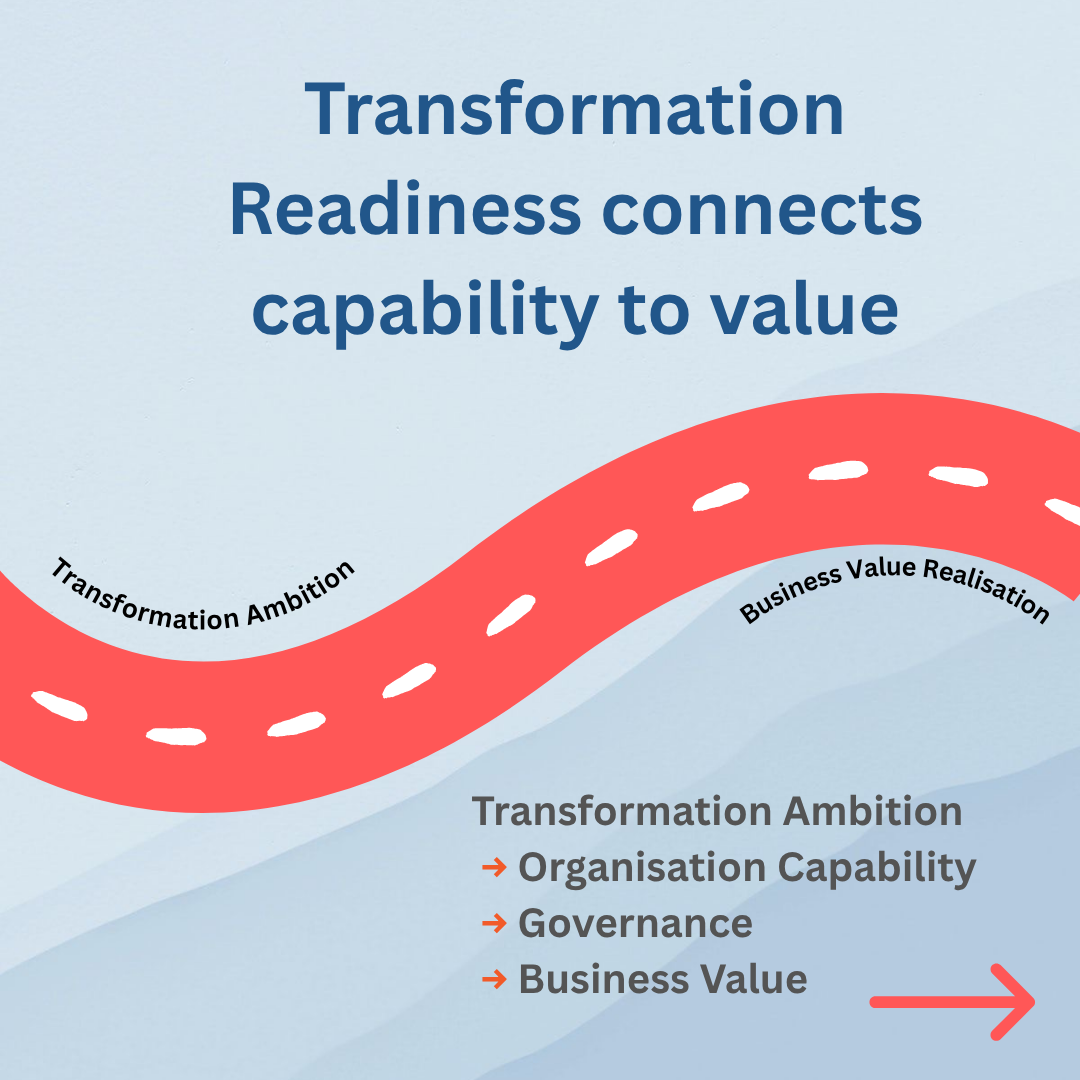
That is the question at the heart of Transformation Readiness.
From Transformation to Business Value



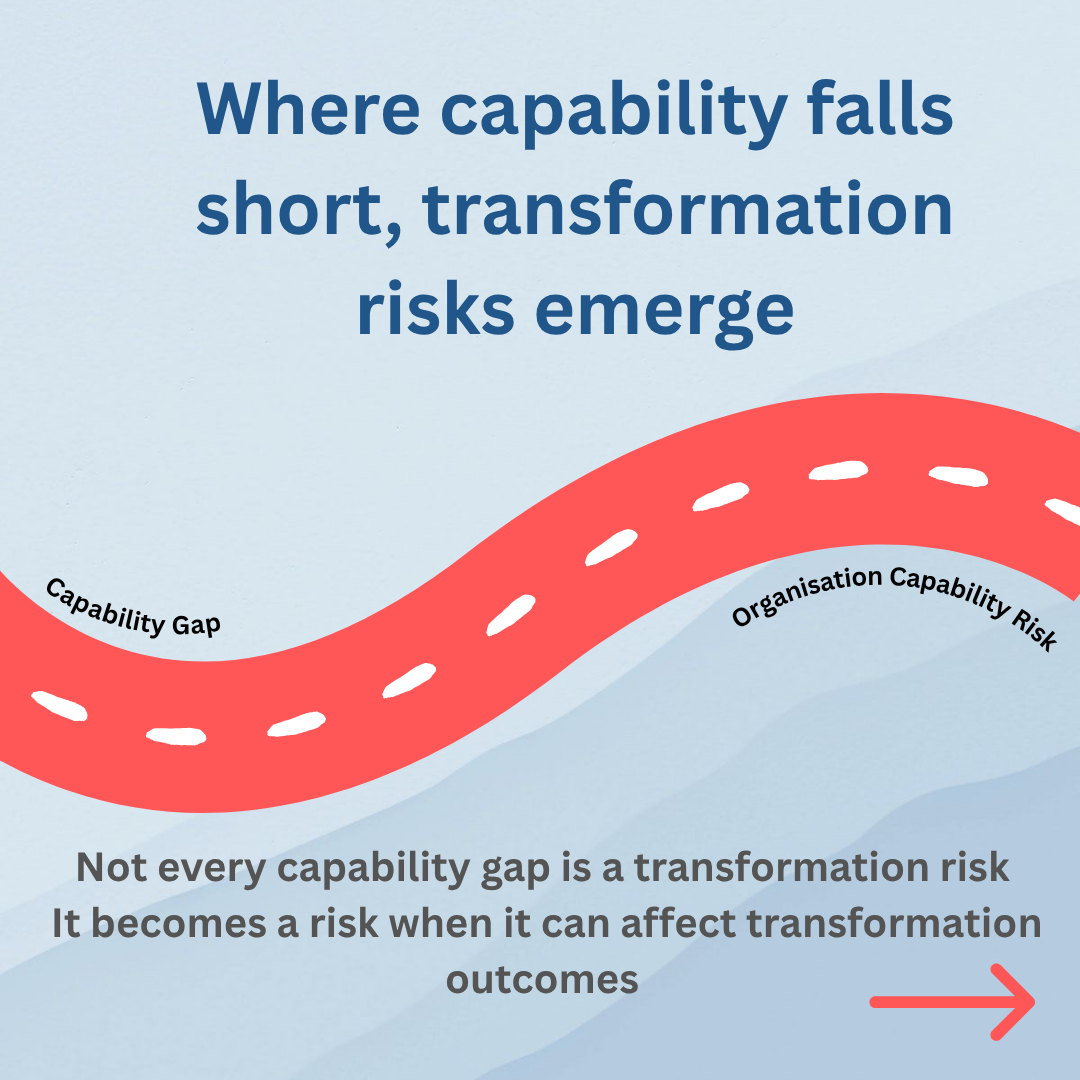

Not Every Capability Gap is a Transformation Risk
A capability gap becomes an Organisation Capability Risk (OCR) when it has the potential to materially affect the outcomes of the transformation.
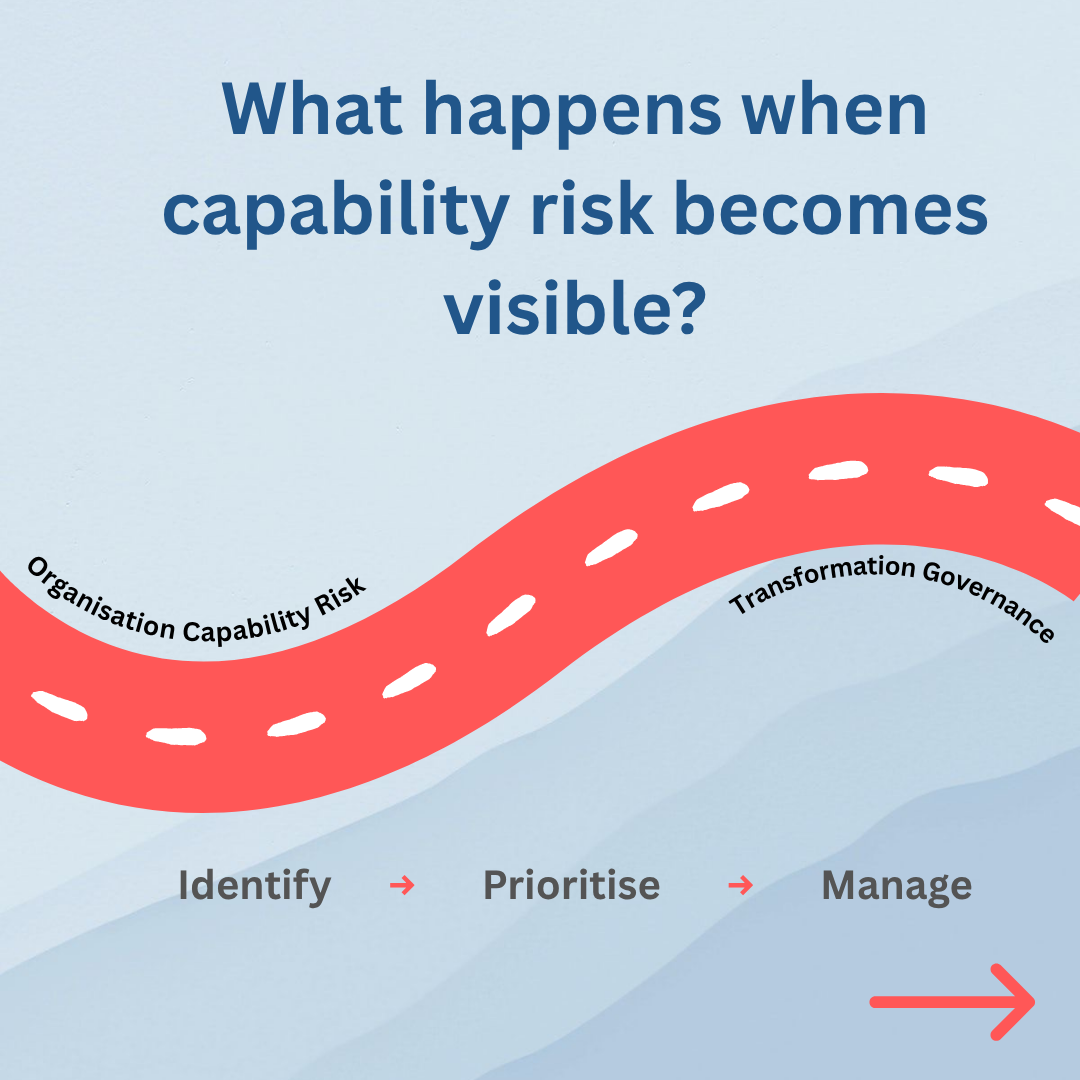
When that happens, the risk needs to become visible within transformation governance — so that it can be assessed, prioritised, assigned and managed.

What are You Measuring?
Are you measuring whether the transformation is being delivered — or whether the organisation is becoming capable of delivering the value it was intended to create?
Why Now?
“The organisation is growing revenue and impact without equivalent growth in costs, powered by modern systems, integrated technology, and confident leaders who can adapt continuously.”
Technology changes.
So must the organisation.
Digital, AI and automation are changing how organisations operate, compete and create value – not just the technology they use.
Organisations that thrive won’t simply be the fastest to adopt new technology.
Organisations that want to thrive will adapt how they work, continually develop the organisation capabilities they need, and turn technology into real business value.
The Age of Acceleration
“We’re entering an age of acceleration. The models underlying society at every level, which are largely based on a linear model of change, are going to have to be redefined.
“Because of the explosive power of exponential growth, the 21st century will be equivalent to 20,000 years of progress at today’s rate of progress. Organizations have to be able to redefine themselves at a faster and faster pace.”
—Ray Kurzweil (2003),
Inventor, Futurist and Director of Engineering at Google
As Jack Welch put it:
“If the rate of change on the outside exceeds the rate of change on the inside, the end is near.”
Transformation Readiness is about identifying the capability gaps that matter — before they become transformation risk.
Where Transformation Readiness Matters Most
Learn more about Transformaton Readiness …. Read More
The CIO Dilemma
CIOs are increasingly accountable for transformation outcomes — while many of the factors that determine those outcomes sit outside IT.
Vision. Governance. Operating models. Skills. Ways of working. Decision-making. Adoption. These all constitute “Transformation Risk”, but are ouside the CIO’s direct control.
Transformation risk doesn’t stop at the IT boundary.
Read More ….
OD Upstream
Organisational Development is often brought in when the transformation has already been designed — to help people “adapt to the change”.
But, by that stage capability gaps are probably already affecting scope, design, timelines, cost, and expected value.
OD needs a seat upstream! Early enough to identify and manage the risks before they become embedded in the programme and where transformation requirements and organisational capability can be considered together.
Read More ….
Designed for Scale
For growing organisations, every stage of scale creates new capability requirements.
Technology may enable growth. But the organisation still has to be capable of adopting and sustaining it.
Scale is not simply more revenue. It is an organisation becoming capable of operating at a different level.
Read More ….
Want to explore Transformation Readiness?
Explore our KnowledgeBase, and our blog for more on Transformation Readiness, Organisational Capability, Transformation Risk and Business Value Realisation.