

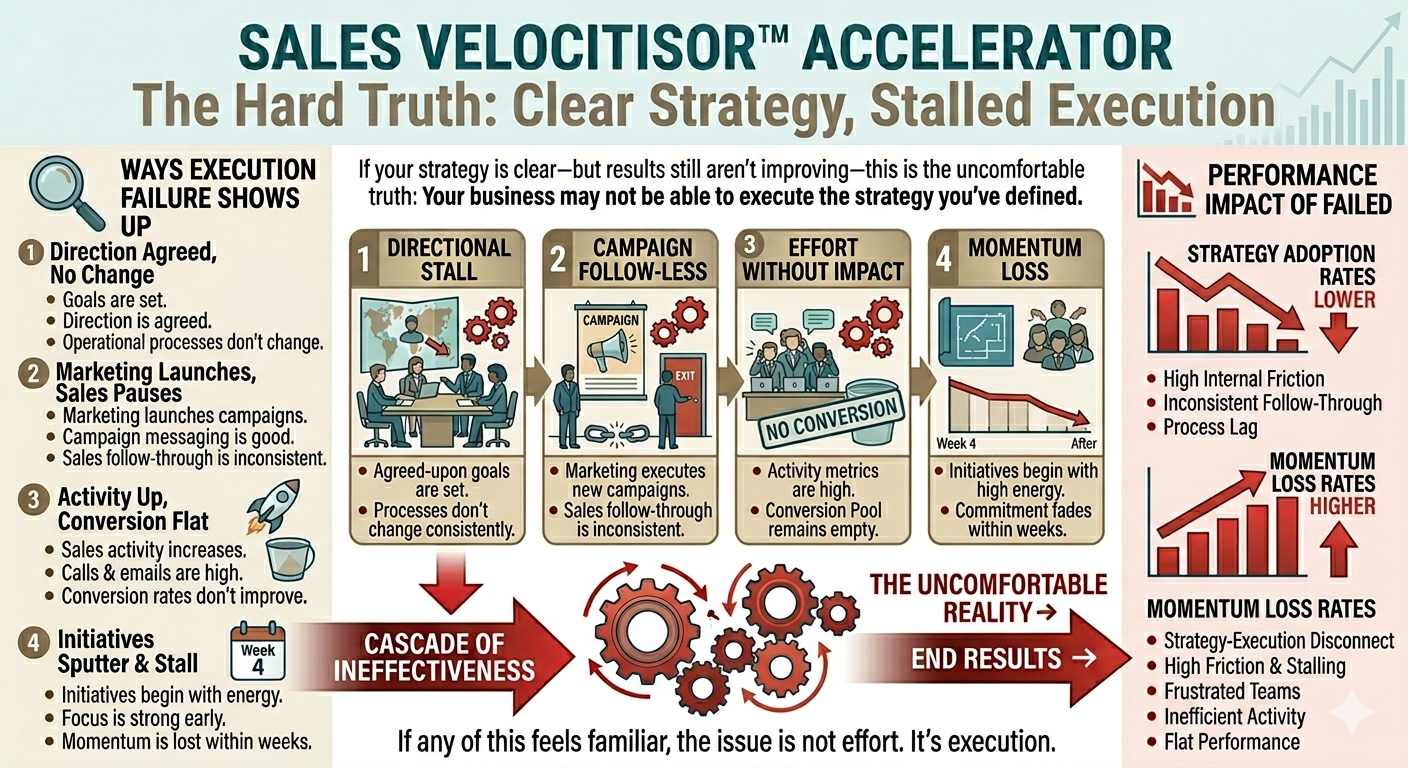
If your Marketing and Sales strategy is clear—but results still aren’t improving—this is the uncomfortable truth:
Your business may not be able to execute the strategy you’ve defined.
This shows up in very specific ways:
- You’ve agreed on direction—but nothing really changes
- Marketing launches campaigns—but sales doesn’t follow through consistently
- Sales activity increases—but conversion doesn’t improve
- Initiatives start strong—but lose momentum within weeks
If any of this feels familiar, the issue is not effort.
It’s execution.
The Misconception
Most organisations assume:
“If we just execute better, results will improve.”
So they push harder:
- More activity
- More meetings
- More tracking
But execution is not just about discipline.
Execution is a function of structure.
Where the Real Problem Sits
Execution breaks down when strategy is not translated into something the business can actually operate.
In many organisations:
- Strategy exists at a leadership level
- But operational teams are left to interpret it
- And each function translates it differently
The result:
- Inconsistent actions
- Misaligned priorities
- Fragmented execution
Strategy Without Operationalisation
When strategy is not operationalised into the revenue system:
- Marketing creates content that sales doesn’t use
- Sales pursues opportunities that marketing didn’t intend to attract
- Customer engagement becomes reactive instead of structured
This is not visible as a single failure.
It shows up as:
- Deals stalling after initial conversations
- Leads entering the pipeline but not progressing
- Teams working hard—but not in the same direction
The Hidden Cost
This is where most businesses get caught.
Because the strategy looks right, the response is:
“We just need to execute better”
So more effort is applied.
But without structure:
More effort amplifies inconsistency
You don’t get better results.
You get:
- More activity
- More complexity
- More frustration
What High-Performing Organisations Do Differently
They don’t rely on interpretation.
They operationalise strategy into:
- Clear, connected processes
- Defined roles across marketing and sales
- Structured flows from lead → opportunity → conversion
- Consistent ways of working across the revenue system
Execution becomes:
predictable, not dependent on individual effort
The Takeaway
Execution is not where strategy succeeds or fails.
Execution is where:
structure is either present—or missing
If your strategy isn’t translating into results:
- It’s not a motivation issue.
- It’s not a capability issue.
It’s a system design issue.
The Real Question
If you’re seeing:
- Activity without progress
- Leads without conversion
- Strategy without traction
Then the question is not:
“Are we executing well enough?”
The real question is:
“Have we structured our revenue system to support execution?”
If this is happening in your business, I run a Structured Growth & Revenue Diagnostic where we identify exactly where your revenue system is slowing down or breaking.
You can:
- Reply with DIAGNOSTIC and I’ll send details
- Or book directly here.