

Most businesses believe they understand their customer.
They can describe:
- The industry
- The company size
- The role of the decision-maker
And yet, despite this, conversion remains inconsistent.
The Problem with “Knowing Your Customer”
In many organisations, customer understanding sits at a very general level:
“We work with SMEs”
“We target decision-makers”
“Our clients are growing businesses”
This may be true—but it’s not useful.
Because:
Broad understanding does not translate into precise engagement
Where This Shows Up
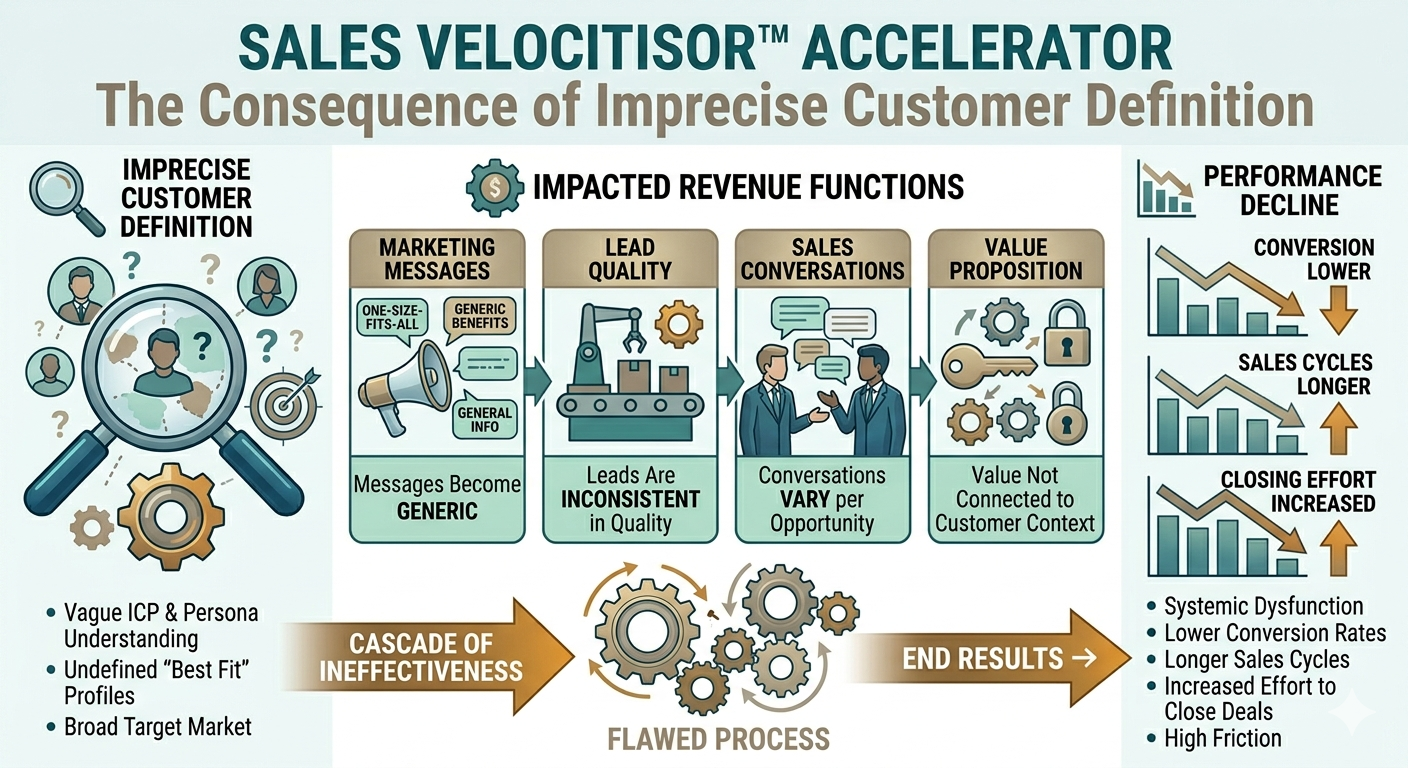
When customer definition lacks precision:
- Marketing messages become generic
- Leads are inconsistent in quality
- Sales conversations vary from one opportunity to the next
- Value is not clearly connected to the customer’s specific context
The result:
- Lower conversion rates
- Longer sales cycles
- Increased effort to close deals
The Real Requirement: Precision
High-performing revenue systems are built on precision, not generalisation.
This means understanding:
- The specific problems your customer is trying to solve
- The context in which those problems exist
- The impact of not solving them
- How they evaluate solutions
Without this, even strong products struggle to convert.
The Hidden Misalignment
One of the most common issues is this:
Marketing and sales are not working from the same definition of the customer
Marketing targets broadly.
Sales qualifies selectively.
And between the two:
→ friction emerges
The Takeaway
“Knowing your customer” is not about description.
It’s about:
defining your customer with enough precision to drive consistent decisions across your revenue system
Without that:
- Messaging drifts
- Targeting weakens
- Conversion suffers
Closing
If results are inconsistent, it’s worth asking:
Do we really understand our customer—
or are we working from assumptions?
If you’re experiencing this, I run a no charge Structured Growth & Revenue Diagnostic where we identify exactly where revenue is slowing down or breaking.