

Over the past few years I’ve had countless conversations with business owners and sales executives who all describe the same frustrating experience.
- “We’ve invested in CRM.”
- “We’ve increased our marketing.”
- “We’ve hired more salespeople.”
- “We’re experimenting with AI.”
- “So why has revenue stopped growing?”
The instinctive response is usually to do more.
- More marketing.
- More technology.
- More sales activity.
- More AI.
Yet for many organisations, the problem doesn’t go away.
In fact, it often gets worse.
That raises an important question:
What if revenue stall isn’t actually a sales problem?
A Different Perspective
As organisations grow, they naturally become more complex.
- They introduce new products and services.
- They expand into new markets.
- They add marketing channels.
- They implement CRM systems.
- They adopt marketing automation.
- They explore Artificial Intelligence.
Every investment is intended to support growth.
Collectively, however, they also increase complexity.
What rarely evolves at the same pace is the system that connects all of these investments together.
The organisation continues to grow.
The revenue system does not.
Revenue Stall Is a Symptom
Most leaders view slowing revenue as a performance issue.
I believe it is something else.
It is a structural signal that the organisation’s Revenue Operating System is no longer capable of supporting the next stage of growth.
Think about it.
- Marketing may be generating leads.
- Sales may be working harder than ever.
- Customer Success may be retaining customers.
- Finance may be tracking every number.
Every team may be performing well individually.
Yet revenue still refuses to scale.
Why?
Because high-performing functions do not automatically create a high-performing system.
Systems Create Performance
Throughout my career, whether working in Organisation Development, Digital Transformation or Revenue Growth, I’ve repeatedly observed the same principle.
Performance is determined by the quality of the system, not by the effort of the people working within it.
The organisations that continue to grow sustainably aren’t necessarily those with the biggest marketing budgets or the most sophisticated technology.
They are the organisations that have modernised the operating systems that govern how work gets done.
Revenue is no different.
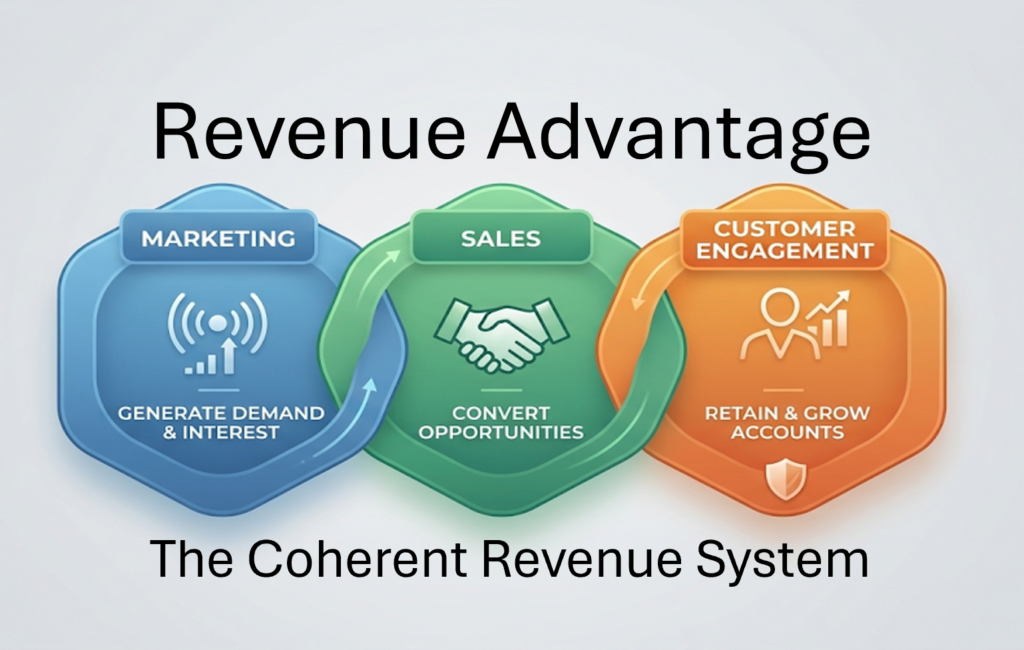
Marketing, Sales and Customer Success are not separate activities.
Together, they form a Revenue Operating System.
When that operating system evolves with the business, revenue continues to scale.
When it doesn’t, growth eventually stalls.
A Better Question
Perhaps the question leaders should be asking is not:
- “How do we improve sales?”
Perhaps it should be:
- “Is our Revenue Operating System capable of delivering the growth we expect from our business?”
That question changes everything.
Because once revenue stall is recognised as a systems problem rather than simply a sales problem, the solution also changes.
Instead of optimising individual departments, organisations begin modernising the system that creates revenue.
That’s what I call Revenue Advantage.
Download the White Paper
I’ve recently published a new white paper:
Revenue Advantage: Modernising Marketing, Sales and Customer Success When Revenue Growth Stalls
You can download it from our website.
In it, we explore:
- Why revenue growth stalls despite increased investment.
- The concept of the Revenue Operating System.
- Why AI and technology alone cannot solve systemic problems.
- How organisations can modernise the way they create revenue.
If your organisation has reached a point where growth has become harder than it should be, I hope it provides a different perspective—and perhaps a different path forward.
I’d love to hear your thoughts.
Have you experienced a point where increasing effort no longer produced increasing revenue? What do you think was really causing it?